Center the Worm, Do Five Turns: Using a Wine Key for Beginners


Cut the foil below the lip, twist the worm into the cork several times, hook the first notch on the bottle rim and lever up halfway, then switch to the second notch and lever again. Finish the last stretch by hand, slow and steady, so the cork slides out with a whisper instead of a pop, just like the slow art of making perfect pour overs that demands patience and care. Keep the worm going in straight, and stop turning once you feel it grab, before it punches through.
TL;DR:
A double-hinge wine key provides controlled, incremental removal of the cork, reducing effort and risk of breaking the cork compared to single-lever openers.
Cutting the foil below the lip prevents wine contact with residual foil, ensuring a cleaner pour and better presentation.
Reinsert the worm and pull slowly if the cork crumbles or resists, and use a two-pronged opener for fragile, old, or flaking corks.
Practicing with an empty bottle and focusing on smooth, slow twisting and lever switching helps develop the muscle memory needed for confident opening.
Finishing the extraction by hand and wiping the rim ensures a quiet, elegant presentation, suitable even for first-timers or formal settings.
Table of Contents
What Is a Wine Key, and What Do You Need to Use One?
A wine key (also called a waiter’s corkscrew) is that little folding tool with a spiral metal screw, a small blade, and a hinged arm that looks part Swiss Army knife, part magic trick. Once you know the parts, the whole thing stops feeling mysterious.
Here’s what you’re working with:
The worm: the metal spiral that twists into the cork. This is your grip point.
The double hinge (lever): two notches that rest against the bottle’s rim, giving you two stages of leverage instead of one big yank.
The serrated knife: a small folding blade for slicing through foil.
The handle: what you’re actually holding, usually with a bit of grip texture.
Pros reach for a double-hinge wine key over a basic single-lever opener because it gives controlled, incremental extraction instead of one big muscle-straining pull. You don’t need much else, though a foil cutter, a clean cloth, and a steady counter make the process smoother if you’re just starting out.
How Do You Actually Open a Bottle With a Wine Key?
This is the part that trips people up on their first few tries, so slow down and follow the sequence in order. Once your hands know the motion, it takes about fifteen seconds.
Stand the bottle upright on a flat, steady surface and give it a quick wipe if it’s been sitting in storage collecting dust.
Cut the foil below the lip. Flip open the serrated knife and score around the capsule just under the bottle’s raised lip, not at the very top. Cutting below the lip keeps the wine from touching old foil residue as it pours, which matters more than it sounds like it should.
Peel off the foil and set it aside, then fold the knife back into the handle so it’s out of your way.
Center the worm on the cork. Tilt it slightly, plant the tip, then straighten it up so it’s going in vertical, dead center.
Twist clockwise, several full turns. Keep rotating the opener, not the bottle. Grip strength on the worm comes from those turns, and going in straight matters more than going in fast.
Stop before you feel it break through the bottom of the cork. You want one curl of metal still visible above the cork’s surface. That’s your cue you’ve gone deep enough without risking loose cork bits in your glass.
Hook the first notch onto the bottle’s rim and press the handle down slowly, lifting the cork about halfway out.
Switch to the second notch, hook it onto the rim, and lever again. This second stage is what makes a wine key so much easier on your wrist than a single-arm opener.
Grab the cork and finish by hand. Once you’re close, stop leveraging and wiggle the cork out gently with your fingers. Finishing this way avoids that dramatic pop and any surprise wine spray, which is exactly how servers do it in restaurants without making a scene.
Pro Tip: If you’re not sure whether you’ve inserted the worm far enough, look for that single visible curl above the cork line. It’s a better gauge than counting turns, since cork density varies bottle to bottle.
What Should You Do When the Cork Fights Back?
Even experienced pourers hit a stubborn cork now and then. Here’s how to handle the usual suspects without ruining the bottle or your evening.
Cork crumbling as you pull? Stop, reinsert the worm into whatever cork remains, and pull slowly rather than yanking harder.
Dealing with an old, dry, or fragile cork? A two-pronged Ah-So opener works better than a worm for corks that are already flaking.
Cork bits floating in your wine? Pour the wine through a fine mesh strainer or coffee filter into a decanter before serving; nobody will know.
Worm went in off-center? Back it out about halfway, straighten it, and re-drive it slowly rather than forcing the crooked angle through.
Cork stuck halfway with the first notch maxed out? That’s exactly what the second notch is for. Switch positions and lever again instead of muscling the first one further.
A cork that shreds badly or smells musty and wet cardboard might be a sign of a flawed bottle rather than user error, so don’t blame your technique if that happens.
How Do You Open Wine Safely and Politely?
A little care goes a long way toward looking like you’ve done this a hundred times, even on your first attempt.
Keep the bottle on a stable surface, and if you’re holding it, brace the base or neck with your non-dominant hand so it doesn’t wobble mid-twist.
Fold the knife back into the handle the second you’re done with the foil. Fingers and open blades don’t mix.
Finish extraction by hand for a quiet release, then wipe the rim with a clean cloth before you pour, clearing any stray dust or cork flecks.
Check your wine key’s worm and hinge occasionally for rust or looseness; a dry cloth and a little oil on the hinge keeps it working for years.
Practice Tips From Blame It On Bacchus
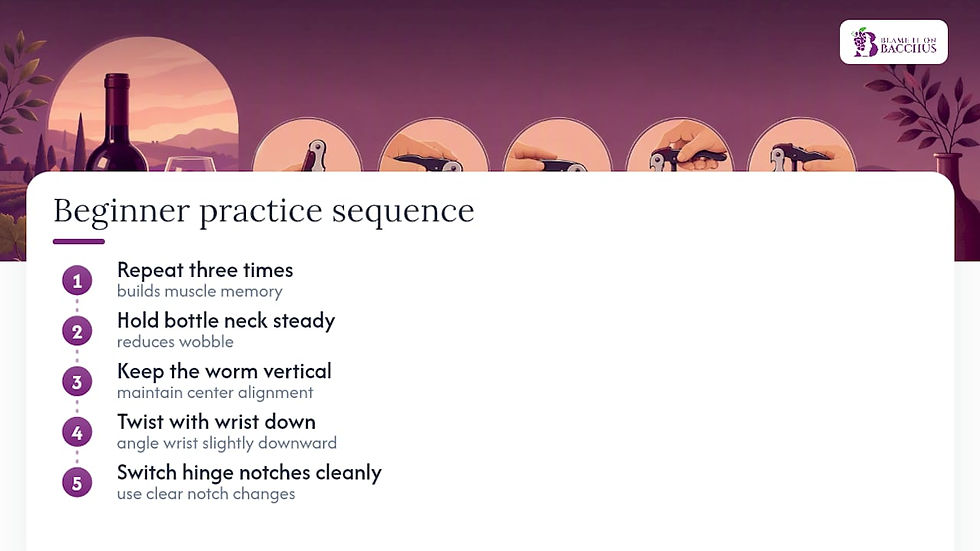
Here’s the honest truth: reading instructions only gets you so far. Grab an empty bottle and run through the motion three times, focusing only on keeping the worm vertical and switching hinge notches cleanly. That kind of repetition builds the muscle memory that no article can hand you.
Angle your wrist slightly downward as you twist, and hold the bottle’s neck steady with your other hand to kill the wobble that throws off first-timers. If you want structured practice instead of trial and error, Blameitonbacchus built an entire beginner class around moments exactly like this one.
Why This Tiny Skill Changes How You Host
There’s something quietly powerful about popping a cork without a struggle in front of friends. That small confidence shift, no fumbling, no apologizing, turns you from someone who dreads the bottle into someone who reaches for it first. Practice on a cheap bottle, mess it up a few times if you have to, then tell us how it went.
— Thomas
Ready to Pour Like You’ve Been Doing This for Years?
Guided practice gets you comfortable faster than solo trial and error ever will, especially with a skill that’s more about feel than theory. If you’d rather skip the guesswork, The Elements of Wine walks beginners through exactly this kind of hands-on technique, alongside the basics of tasting and pairing.

And if your current opener is the flimsy wing kind that makes you sweat through every bottle, the Blame It On Bacchus Waiter’s Corkscrew gives you the proper double-hinge leverage this whole guide is built around. Grab the class, grab the tool, and open your next bottle like you mean it.
Sources
FAQ
How many turns should the worm take into the cork?
About five full turns is the standard target, enough to grip the cork firmly without driving the tip through the bottom.
Why do you cut the foil below the lip instead of at the top?
Cutting below the bottle’s lip keeps the wine from contacting old foil residue as it pours, giving you a cleaner glass.
What if the cork breaks apart while I’m pulling it?
Reinsert the worm into the remaining piece and pull slowly, or switch to a two-pronged Ah-So opener if the cork is old and dry.
Is a double-hinge wine key better than a wing corkscrew for beginners?
Yes. The two-notch lever system spreads the pulling force across two stages, which takes far less arm strength than a single-pull wing opener.
Does Blameitonbacchus teach this technique in its wine classes?
Yes, the beginner-focused class walks through bottle-opening technique alongside tasting fundamentals, and the brand also sells its own waiter’s corkscrew for practicing at home.
Recommended
Comments