The Role of Sulfites in Wine: What You Need to Know


Sulfites in wine are sulfur-based compounds that protect wine from oxidation and microbial spoilage, keeping it fresh from the cellar to your glass. You’ve probably spotted “contains sulfites” on a wine label and wondered what that actually means for your drinking experience. The role of sulfites in wine goes way beyond a warning label. These compounds are the unsung heroes of winemaking, working behind the scenes to preserve flavor, prevent spoilage, and keep your favorite bottle tasting exactly as the winemaker intended. Even wines labeled “no added sulfites” contain natural sulfites from fermentation, so every wine lover benefits from understanding what they actually do.
How do sulfites preserve wine and protect its quality?
Sulfur dioxide (SO2) is the technical industry term for the sulfite compounds used in winemaking, and it does two critical jobs at once. First, it acts as a microbial traffic cop, suppressing unwanted bacteria and wild yeasts that would otherwise hijack fermentation and produce off-flavors. Second, it works as an antioxidant, binding to oxygen molecules before they can brown your wine or create stale, flat aromas.
Here is where it gets a little science-y, but stick with me. Not all SO2 in wine works the same way. Winemakers track two forms: free SO2 and bound SO2. Bound SO2 is inactive, locked up by compounds like acetaldehyde, sugars, and pigments. Only free SO2 actually protects the wine. Within free SO2, the real workhorse is molecular SO2, the only form with direct antimicrobial activity.

Wine pH plays a huge role here. At typical wine pH levels of 3–4, molecular SO2 is less than 5% of free SO2, with bisulfite making up the rest. That means winemakers at higher pH levels need to add more total SO2 just to maintain enough molecular SO2 for effective protection. It is a constant balancing act.
Pro Tip: If you are curious about how fermentation and sulfites interact at a chemical level, the science behind wine fermentation is a fascinating rabbit hole worth going down.
Without adequate SO2, wines risk developing:
Vinegary notes from acetic acid buildup
Oxidative browning in both color and aroma
Sulfurous funk from unchecked microbial activity
Flat, lifeless fruit flavors from oxidative degradation
What impact do sulfites have on wine flavor and aroma?
Sulfites preserve freshness and fruit flavors by stopping oxidative reactions before they strip the wine of its character. Think of SO2 as a bodyguard for your Sauvignon Blanc’s zippy citrus notes or your Pinot Noir’s delicate red berry aromas. Without it, those flavors degrade fast.
That said, too much of a good thing causes problems. Excessive SO2 causes sulfurous odors, often described as a burnt match smell, and can make wine taste harsh and flat. Skilled winemakers dose carefully to stay well below that sensory threshold.
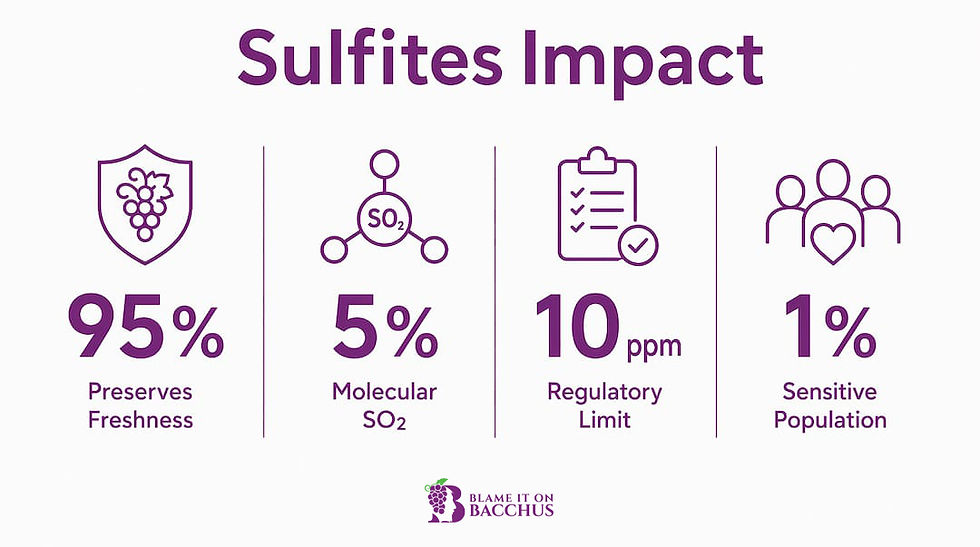
Here is a myth worth busting right now. Many wine drinkers blame sulfites for their post-wine headaches. The science does not back that up. Sulfites are not the likely cause of the “red wine headache.” Histamines, tannins, and alcohol are far more probable culprits. Red wines actually contain less SO2 than white wines, yet they get blamed for headaches more often. That alone should tell you something.
Sulfite levels also vary significantly by wine style:
Sweet wines carry the highest SO2 levels because residual sugar creates more binding sites, requiring extra free SO2 for protection
White and rosé wines need more SO2 than reds because they lack tannins, which provide some natural antioxidant protection
Red wines generally carry lower sulfite levels thanks to those tannins doing some of the heavy lifting
Dry wines typically need less SO2 than sweet wines of the same color
What does wine labeling say about sulfite levels and safety?
US and EU regulations require a “contains sulfites” warning on any wine with 10 ppm or more of sulfur dioxide. Here is the kicker: yeast naturally produce 10–20 ppm during fermentation. That means nearly every wine on the shelf carries this label, even bottles with zero added sulfites.
The health picture is clearer than most people think. Only about 1% of the population, mainly sulfite-sensitive asthmatics, experience clinical reactions to sulfites. Those reactions typically show up within 15–30 minutes as respiratory symptoms, not headaches. For the other 99% of wine drinkers, sulfites at normal wine levels pose no clinical concern.
Wine type | Typical SO2 range | Key reason |
Dry red wine | Low | Tannins provide antioxidant backup |
Dry white wine | Moderate | No tannins; needs more SO2 protection |
Sweet white wine | High | Residual sugar binds SO2; more needed |
Organic/no added sulfites | Very low | Natural fermentation levels only |
Organic and biodynamic wines sit in an interesting spot. USDA Organic certification prohibits added sulfites, but natural fermentation still produces 10–20 ppm. Those wines still require labeling and are not truly sulfite-free. “Natural” wines follow no single legal standard, so sulfite levels vary widely by producer. If you want the full story on what organic really means for your glass, the organic wine guide at Blameitonbacchus breaks it down without the fluff.
Pro Tip: If you are sensitive to wine compounds, try a dry red with low residual sugar before blaming sulfites. You might find histamines or tannins are the real culprits.
How do winemakers manage sulfites during production?
Winemakers add SO2 at several key moments throughout the production process. Each addition has a specific purpose, and the timing matters as much as the dose.
At crush. The first SO2 addition happens when grapes are crushed. This suppresses wild yeasts and bacteria on the grape skins, giving the winemaker’s chosen yeast strain a clean environment to take over fermentation.
During fermentation. SO2 levels drop as fermentation progresses, because the compound binds to fermentation byproducts like acetaldehyde. Winemakers monitor free SO2 throughout and may adjust levels to maintain protection without stifling the yeast doing the work.
After fermentation. Once fermentation ends, the wine is vulnerable to oxidation and microbial spoilage. A targeted SO2 addition at this stage stabilizes the wine before aging begins.
At bottling. The final and most critical addition. Winemakers calculate the exact free SO2 needed to protect the wine through its shelf life, accounting for the wine’s pH, residual sugar, and expected storage conditions.
Ongoing monitoring. Throughout aging, winemakers test free vs. bound SO2 regularly. High-pH wines and wines with significant residual sugar demand more attention because they consume free SO2 faster.
Artisanal and organic producers who want to reduce sulfite reliance use alternative techniques. Careful oxygen management during aging, sterile filtration, and cold stabilization all reduce microbial risk. Some producers use inert gas blanketing with nitrogen or argon to limit oxygen exposure. These methods reduce but rarely eliminate the need for SO2 entirely, which is why even low-intervention wines carry some sulfite presence.
Key takeaways
Sulfites are a non-negotiable part of winemaking chemistry, protecting flavor, preventing spoilage, and keeping nearly every wine on the market shelf-stable.
Point | Details |
Sulfites preserve wine quality | SO2 prevents oxidation and microbial spoilage that would otherwise ruin flavor and aroma. |
All wines contain some sulfites | Natural fermentation produces 10–20 ppm, so no wine is truly sulfite-free. |
Headaches are not caused by sulfites | Histamines, tannins, and alcohol are the more likely culprits behind wine headaches. |
Sulfite levels vary by wine style | Sweet and white wines carry more SO2; dry reds carry the least due to tannin protection. |
Winemakers dose SO2 at multiple stages | Additions at crush, fermentation, and bottling each serve a distinct preservation purpose. |
Sulfites deserve a better reputation
Here is my honest take after years of tasting and learning about wine: sulfites are one of the most misunderstood ingredients in the bottle. The “sulfites cause headaches” myth has taken on a life of its own, and it frustrates me every time I see it repeated as fact. Red wine has less SO2 than white wine. If sulfites were the villain, white wine drinkers would be the ones complaining. They are not.
What I have noticed is that wine drinkers who understand sulfites make better choices. They stop chasing “sulfite-free” labels as a health fix and start paying attention to what actually matters, like tannin levels, histamine content, and alcohol percentage. That shift in focus leads to genuinely better tasting experiences.
The “natural wine” movement has done some good by pushing winemakers to think critically about every addition they make. But the framing of sulfites as inherently bad has muddied the waters. A wine made without adequate SO2 management is not more natural. It is just more likely to taste like vinegar by the time it reaches your glass.
My advice? Learn to read sulfite levels in context. A high-SO2 sweet Riesling is not a red flag. It is a sign the winemaker knew what they were doing. And if you want to go deeper on common wine myths, there is a lot more to unpack beyond just sulfites.
— Thomas
Wine knowledge that actually sticks with Blameitonbacchus
If sulfites have you curious about what else is going on inside your glass, you are going to love what Blameitonbacchus has put together.

The Elements of Wine program at Blameitonbacchus digs into wine components including preservation chemistry, flavor development, and what actually makes a wine taste the way it does. It is built for curious wine lovers who want real answers without wading through textbooks. And if you want to wear your wine passion on your sleeve (literally), check out the wine-themed apparel at Blameitonbacchus. Nothing says “I know my SO2” like a great wine lover’s tee to go with your next bottle.
FAQ
What is the role of sulfites in wine?
Sulfites act as both an antimicrobial agent and an antioxidant in wine, preventing spoilage from bacteria and wild yeasts while protecting flavor and color from oxidation.
Are sulfites in wine safe to drink?
For the vast majority of people, yes. Only about 1% of the population, mostly sulfite-sensitive asthmatics, experience clinical reactions, and those reactions are respiratory, not headaches.
Do sulfites cause wine headaches?
Sulfites are not the likely cause of wine headaches. Histamines, tannins, and alcohol are more probable culprits, and red wine contains less SO2 than white wine despite being more associated with headaches.
Can a wine be completely sulfite-free?
No. Yeast naturally produce 10–20 ppm of sulfur dioxide during fermentation, so even wines with no added sulfites still contain naturally occurring sulfites and require labeling.
Why do sweet wines have higher sulfite levels?
Residual sugar in sweet wines binds to free SO2, reducing its protective effect. Winemakers add more total SO2 to maintain enough free SO2 for effective preservation throughout the wine’s shelf life.
Recommended
Comments