Wine Trivia Questions (With Answers) for Your Next Wine Night


You want wine trivia questions you can read out loud tonight, with answers you can trust. Here they are: four rounds, from “I just opened my first bottle” to “okay, show-off,” plus a list of questions to ask while you taste and a simple way to keep score. Pour something, grab a pen, and let’s get this wine party started.
I checked the answers against university extension programs, a major broadcaster’s tasting guide, and a university tasting course, so nobody at your table can win an argument with “my cousin says otherwise.” Where a question comes from a specific source, you’ll find the link right at the answer.
Table of Contents
How to Run a Wine Trivia Night Without Making It Weird
Wine trivia has a reputation for being a snooty pop quiz. It doesn’t have to be. The best games feel like a pub quiz where the prize is bragging rights and maybe the last glass.
A few ground rules I swear by:
Keep teams small. Two to four people per team. Bigger groups let one wine nerd answer everything while the rest nibble cheese.
Read the question twice. Wine terms trip people up. Nobody should lose a point because they misheard “varietal.”
Award a bonus point for explaining the answer. This turns a quiz into a mini class, which is the whole point.
Mix the pours with the rounds. Try a cool-climate white during the climate round and a bold red during the tannin questions. Your tongue becomes the study guide.
Keep a water pitcher on the table. A sharp brain beats a tipsy one.
Pro tip: print the questions without the answers, and keep the answer key with whoever is hosting. The host also gets to be dramatic when revealing the answers. That’s a perk.
Round 1: Wine Basics (Easy Wins)
This round is for the beginners at your table, and for confidence. Everyone should walk away with at least a few points.
1. What does yeast do during fermentation?
Answer: It converts the sugar in grape juice into alcohol and carbon dioxide, according to Penn State Extension. Tiny fungi, big party. If you want the full story behind the bubbles and flavor, our wine fermentation explainer walks through it.
2. Name the five basic characteristics used to describe a wine.
Answer: Sweetness, acidity, body, tannin, and alcohol, per Penn State Extension. Give half a point for every three correct. Sweetness is the one people mix up most, so if your table struggles, send them to our guide on wine sweetness.
3. According to a WSET educator quoted by BBC Food, what are the two main factors that distinguish one wine from another?
Answer: Grape variety and climate, as explained in BBC Food’s beginner’s guide to tasting wine. Remember this pair. It unlocks about half the questions in this article.
4. Chardonnay, Merlot, Sauvignon Blanc, Burgundy, Rioja: which are grapes and which are regions?
Answer: Chardonnay, Merlot, and Sauvignon Blanc are grape varieties. Burgundy and Rioja are regional wine names, BBC Food explains. This one catches a lot of people, because plenty of labels name the grape and plenty name the place. Need a primer? Try our post on grape varietals.
5. What does “vintage” on a label tell you?
Answer: The year the grapes were grown and harvested, not the year the wine was bottled, according to the University of Minnesota’s wine tasting course. Bonus point if someone at the table says “so it’s the harvest year, not the bottling year.”
6. What is the standard order of tasting a wine?
Answer: Look at it, swirl it, smell it, then sip it. BBC Food lays it out as appearance, aromas, then the palate, and finally the finish once you swallow or spit. The University of Minnesota version adds a second swirl and sniff before tasting.
7. Why does some red wine make your mouth feel dry?
Answer: Tannins. Red wine generally uses black grapes fermented with their skins, and the tannins from them can create a drying sensation, says BBC Food. Think of that fuzzy feeling after strong black tea.
8. In the United States, when does the grape harvest generally happen?
Answer: Between August and October, depending on the variety and the style of wine, per Penn State Extension. Early sparkling-wine grapes come off first, while later reds hang around longer.
Round 2: Grapes, Regions, and Climate (Medium Heat)
Now we get geographic. These questions reward people who’ve been paying attention to labels.
9. Which region gives Champagne its name?
Answer: Champagne. Yes, it really is that simple, and yes, someone at your table will overthink it. The answer shows up in this list of basic wine facts from Napa Valley. Follow-up bonus: it’s a place first and a style second.
10. Which climate generally gives wines higher acidity: warm or cool?
Answer: Cool. Cooler climates favor higher acidity, brighter flavors, and a lighter body, according to the Napa Valley basic wine facts guide. Acidity is what makes your mouth water after a sip, so that crisp, zippy white you love? Probably cool-climate.
11. What tends to happen to wines from warmer climates?
Answer: They generally show riper fruit flavors, higher alcohol, lower acidity, and a fuller body, the same guide explains. Picture a sunny-day wine: plush, rich, and a bit lazy on the sofa. Want to go deeper? Our post on the role of climate in wine breaks it down in plain language.
12. Which U.S. state produces about 80 percent of the country’s wine?
Answer: California, per the Napa Valley wine facts roundup. That’s not a typo. One state is doing most of the heavy lifting.
13. Same vineyard, same grape, one tiny hillside difference. What’s the fancy term for these small local climate quirks?
Answer: Microclimates. A slope, a breeze, or a nearby lake can change how a grape ripens. If someone at your table wants to nerd out, hand them our taster’s guide to wine microclimates.
14. True or false: “Burgundy” is a grape.
Answer: False. It’s a region, as noted in question 4. Use this as a tie-breaker when two teams are neck and neck.
15. Which two things shape how a grape ends up tasting in your glass?
Answer: Grape variety and climate, again. Yes, I’m repeating myself on purpose. If your guests remember one thing from the night, make it this. Our walkthrough on how grapes shape wine flavor shows what that looks like in real tastings.

Round 3: Winemaking (For the Show-Offs)
This is where the table gets quiet and someone suddenly remembers a documentary.
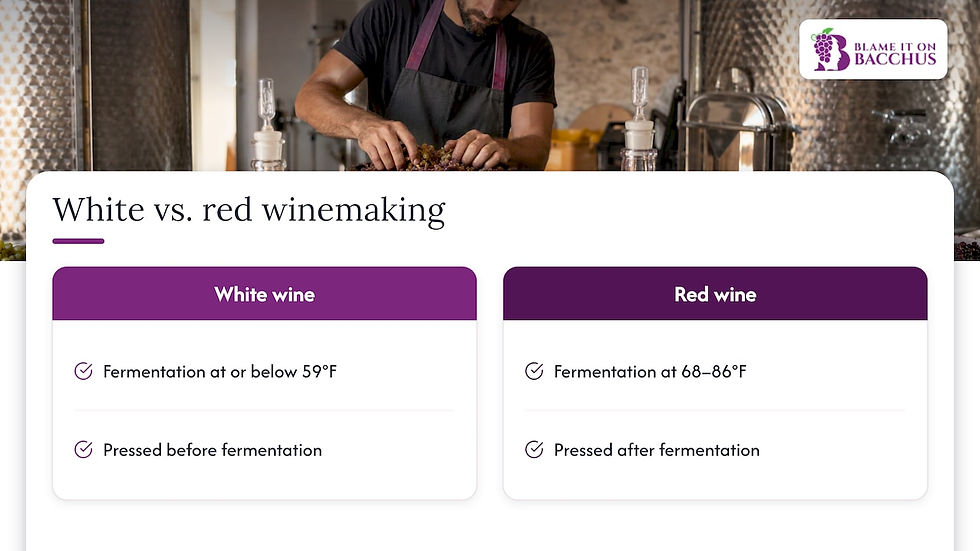
16. At roughly what temperature is white wine typically fermented?
Answer: At or below 59°F, according to Penn State Extension. Cooler fermentation helps keep delicate, fresh aromas in the glass.
17. And what is the typical range for red wine fermentation?
Answer: 68 to 86°F, the same Penn State resource says. Warmer fermentation helps pull color and structure from the skins. Give a point to anyone within a few degrees.
18. Which gets pressed before fermentation, white wine or red wine?
Answer: White. The University of Minnesota lesson explains that white wine is pressed before fermentation, while red wine is pressed after fermentation, with the juice, skins, seeds, and pulp all together. That’s why red gets its color and its tannins.
19. What’s the name for the year-to-year difference in a wine caused by a growing season?
Answer: Vintage variation. Since a vintage is simply the harvest year, every season’s weather leaves its mark. A hot year and a cool year can make the same producer’s wine taste quite different. This one is a judgment call, so award points for any answer that mentions weather and harvest year.
20. What’s the difference between a grape’s “primary” flavors and the flavors that come later?
Answer: Primary aromas come from the grape itself. Others develop later during winemaking and aging. If your table wants the vocabulary, our posts on what wine aroma is and the three bouquet types are a friendly start.
Round 4: Tasting Smarts
These are the questions that actually make you better at drinking wine. Save them for last, because by now everyone has a glass in hand.
21. In tasting, what does “body” describe?
Answer: How full or light the wine feels in your mouth. BBC Food lists body alongside sweetness, alcohol warmth, and bitterness as things to consider on the palate. Think skim milk versus whole milk.
22. What can you feel in your throat that signals higher alcohol?
Answer: Warmth. The same BBC guide lists alcohol warmth among the palate cues. It’s a gentle heat at the back of the mouth, not a burn.
23. What should you do after you swallow or spit?
Answer: Think about the finish, meaning how long the flavors linger. The University of Minnesota course also points out retronasal breathing after swallowing, which lets you catch more aroma.
24. Is “dry” the same as “tannic”?
Answer: Nope. “Dry” in wine usually means not sweet. A tannic wine gives that drying, grippy feeling on your gums and cheeks, as described above. Our wine terminology guide is handy for settling this argument.
25. Sweetness, acidity, body, tannin, alcohol: which one makes your mouth water?
Answer: Acidity. That mouth-watering, refreshing quality is something BBC Food suggests you assess when you taste.
Questions to Ask at a Wine Tasting
Trivia isn’t only about answers. If you’re headed to a tasting room, a class, or a friend’s living room, these are the questions that turn “mm, it’s red” into real conversation. I pulled them from the tasting sequence in BBC Food’s guide.
What grape or regional style is this? Knowing the grape or the place gives you a map for the rest.
What do you smell? Start broad: is the fruit citrus, stone, tropical, red, or black?
Is it sweet or dry? Trust your first impression.
How mouth-watering and refreshing is it? That’s acidity doing its job.
How full is the body? Light, medium, or full.
Does the alcohol feel warm? A little heat is a clue about the wine’s strength.
Do the tannins feel drying? Mostly a red wine question.
Do you notice oak, spice, or a long finish? These show up once you’ve sipped and swallowed.
What did the color tell you? Appearance is your first hint, so go back and check it against what you tasted.
If you’re newer to smelling wine, try our wine aroma examples. Having a few real-life comparisons (lemon, peach, strawberry, blackberry) makes sniffing much less awkward.
A Quick Beginner Wine Quiz Scorecard
Want a shorter game? Use questions 1, 2, 4, 5, 7, 10, 12, and 21 as an eight-question beginner wine quiz. Here’s how I’d score it:
Score | Title you’ve earned | What to do next |
0 to 2 | Cork Curious | Keep tasting and keep asking questions. |
3 to 5 | Rising Sipper | Start comparing grapes and climates side by side. |
6 to 7 | Cellar Insider | Try the winemaking round next time. |
8 | Full Bacchus | Host the next one. |
No one is going to be graded for real. The goal is to make wine feel less like homework and more like a good time.
Our Take on Why Trivia Works
We think wine trivia is one of the most underrated ways to learn. Nobody likes being lectured about tannins, but give people a game, a glass, and a little friendly rivalry, and suddenly they’re asking why a cool region makes zippy wines. That’s the idea behind everything we do at Blame It On Bacchus: fun, approachable wine education for beginners, with a sense of humor and prices that don’t make your wallet cry. Our classes are designed to build on exactly the kinds of questions in this article, such as grapes, climate, tasting, and pairing, so you can go from guessing to knowing why. If you’ve got a group, we also offer private classes, including guided tastings and custom sessions, which are a great way to turn a wine night into something people actually remember. Thomas
Want to Win Every Wine Night? Start Here
If this quiz left you thinking “I want to actually know this stuff,” we built our beginner classes for you. The Elements of Wine is $75, The Elements of Tasting is $50, and The Elements of Food and Wine Pairing is $75, all as one-off purchases. If you’re curious about specific regions, our Passport classes for France, Italy, Spain, Germany, California, and Australia are $125 each.

Hosting a party or a team event? Check out our private classes for guided tastings, food and wine pairing, or a custom class. Shopping for a wine lover instead? Our eGift card is an easy win, and our wine-themed merchandise makes a fun prize for your trivia winner.
Tips for Writing Your Own Wine Trivia Questions
Once you’ve played through this set, you’ll probably want to write your own. A few thoughts from the host’s chair:
Write about what you’ve just poured. If tonight’s bottle is a Sauvignon Blanc, ask about its grape, its style, or its home region.
Mix question types. Combine multiple choice, true or false, and open answers so different brains get a moment to shine.
Keep one “gimme” per round. A very easy question gives the table momentum.
Verify your answers. Wine lore is full of myths. Check with a university extension, a tasting course, or an educational source before you declare a winner.
Don’t punish guessing. A wrong answer is a chance for the host to say something interesting.
And always keep a few “explain it” questions in your back pocket. Asking someone to describe the difference between a grape and a region does more for learning than any trick question.
FAQ
What are good wine trivia questions for beginners?
Start with the basics: what yeast does in fermentation, what a vintage is, which wine names are grapes and which are regions, and what tannins feel like. Those questions in Round 1 build the vocabulary for everything else. Keep the tone playful, and you’ll have a beginner-friendly game in minutes.
How many questions should a wine trivia night have?
Twenty to twenty-five questions across three or four rounds is a sweet spot. That’s enough for people to settle in without the game dragging past the last pour. For a short icebreaker, eight questions works well.
What are good questions to ask at a wine tasting?
Ask what grape or style it is, what you smell, whether it’s sweet or dry, how refreshing it feels, how full the body is, and whether you notice warmth, drying tannins, or a long finish. Those questions follow the same order that BBC Food recommends for tasting.
Can I use these wine quiz questions for a virtual game night?
Yes. Read each question over video, have teams type answers in the chat, and reveal the answer key after each round. Ask everyone to pour something similar beforehand so the tasting round works for the whole group.
Sources
Recommended
Comments