How to read wine labels for smarter choices

Updated: May 25

TL;DR:
Most wine labels contain legally required information like brand, type, origin, and ABV, which are essential for informed choices. Understanding how to decode these core elements transforms wine shopping from guesswork into a confident and enjoyable experience. Mastering label literacy helps you predict wine style, appreciate provenance, and become a more knowledgeable conversation partner.
Standing in the wine aisle, staring at rows of bottles with tiny text and unfamiliar words, is a rite of passage for every new wine drinker. Sound familiar? You’re not alone. Most beginners feel like they’re trying to decode a foreign language while someone’s cart impatiently nudges theirs from behind. But here’s the good news: wine labels follow a pattern, and once you crack that pattern, you’ll feel confident grabbing exactly what you need. I’m here to spill the beans on how reading a wine label can transform your wine buying from guesswork into something genuinely enjoyable and smart.
Table of Contents
Key Takeaways
Point | Details |
Know the main fields | Brand, class, origin, vintage, and ABV are the essentials on any wine label. |
Step-by-step reading | Read required legal info first, then consider optional details for deeper insights. |
Vintage isn’t always critical | Non-vintage wines can be just as enjoyable as vintage, depending on preference. |
Avoid common mistakes | Trust core facts on the label over marketing phrases and hype. |
Use new skills to choose confidently | Practicing label reading makes wine selection easier and more satisfying. |
Core elements of a wine label: What matters most
Let’s cut through the noise first. A wine label has two types of information: the stuff that’s required by law, and the stuff that’s optional marketing flair. Knowing which is which saves you time and money.
According to TTB regulations, U.S. wine labels are governed by TTB rules (27 CFR Part 4), and the required label fields include the brand name, class or type, appellation of origin, ABV, net contents, bottler or importer info, and when applicable, sulfite and health warning statements. These are your anchors. Everything else is noise until you’ve locked these down.
Here’s a quick breakdown of the fields you’ll always find on a compliant U.S. wine label:
Brand name: Who made it. Think of this like the restaurant name before you even look at the menu.
Class/type: Is it a table wine, a dessert wine, a sparkling wine? This tells you what kind of party you’re walking into.
Appellation of origin: Where the grapes were grown. Napa Valley, Willamette Valley, Tuscany. This one matters more than most beginners realize.
ABV (Alcohol By Volume): How strong the wine is. More on this in a minute.
Net contents: Usually 750 ml for a standard bottle.
Bottler/importer info: Who put it in the bottle and where.
Sulfite declaration: Required if sulfites exceed a certain level.
Health warning: That standard government warning about alcohol and pregnancy.
Get comfortable with the wine terminology explained around these fields and you’re already ahead of most shoppers in that aisle.
Here’s a simple comparison to show what’s required versus optional:
Label element | Required by law? | Why it matters |
Brand name | Yes | Identifies producer |
Class/type | Yes | Sets expectations for style |
Appellation | Yes | Signals origin and flavor profile |
ABV | Yes | Tells you alcohol strength |
Vintage year | No (but regulated if used) | Harvest year context |
Tasting notes | No | Marketing, subjective |
Awards and scores | No | Helpful but promotional |
Food pairing suggestions | No | Nice, not factual |
Pro Tip: Always scan the required fields first before you let a fancy label design or gold medal sticker sway you. The core fields tell the real story. Browse the wine basics guide to get comfortable with these fundamentals fast.

Step-by-step: Decoding a label for your needs
With the key elements in mind, here’s how to systematically decode any wine label for your next purchase. Think of it like reading a two-layer document.
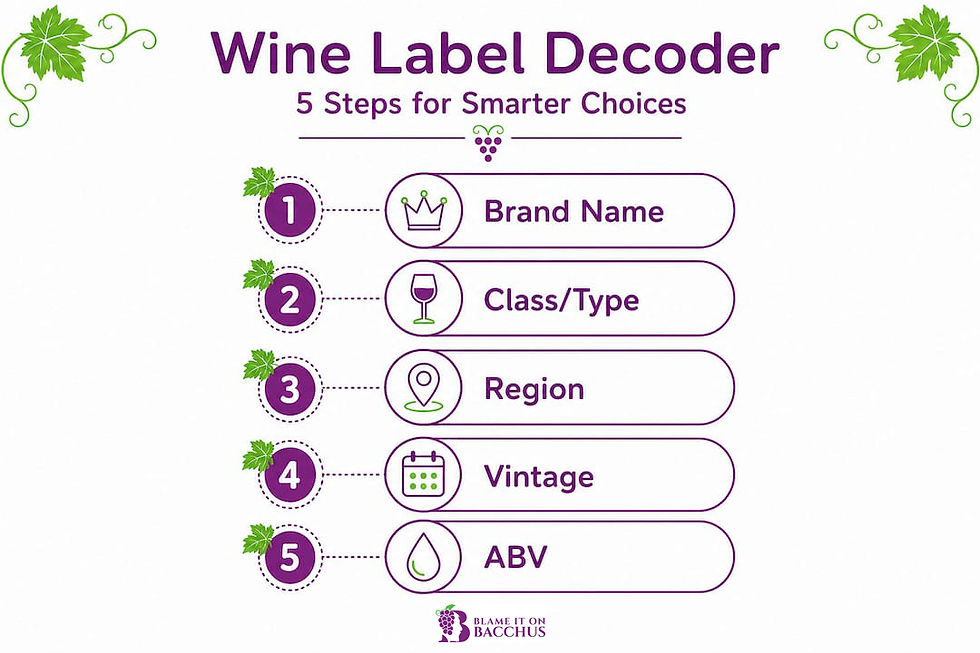
Label reading works best when you treat it as a two-layer document: layer one covers legally required information like what it is, where it’s from, and how strong it is, while layer two covers optional context such as producer story, tasting notes, and awards that may influence preference but should not replace the core fields.
Here’s your step-by-step playbook:
Read the brand name and class/type first. Is this a Cabernet Sauvignon or a Pinot Grigio? Knowing the grape or wine style immediately helps you predict flavor. Bold and dark? Probably a red. Light and crisp? Likely a white.
Check the appellation of origin. This tells you where the grapes were grown. A Burgundy Pinot Noir and a California Pinot Noir can taste completely different even though they share a grape variety. Origin is everything in wine.
Look at the ABV. A wine at 11% ABV is lighter and often crisper. One at 15% is fuller bodied and more warming. This is your first taste preview without opening the bottle.
Scan for the vintage. That four-digit year on the label? That’s when the grapes were harvested. It helps you understand what you’re drinking in context, especially for wines from regions where weather variation matters.
Check the bottler/importer info. This tells you who’s responsible for the quality you’re about to experience. Some importers are known for curating top-quality bottles.
Now read layer two. Once you’ve got the hard facts, go ahead and enjoy the tasting notes, the producer story, the food pairing suggestions. Just don’t let them replace the core facts.
Here’s a quick example walkthrough. Imagine you’re holding a bottle labeled:
Field | What you read | What it means |
Brand name | Silver Oak | Established Napa producer |
Class/type | Cabernet Sauvignon | Bold, full-bodied red |
Appellation | Napa Valley, California | Premium growing region |
Vintage | 2020 | Harvest year was 2020 |
ABV | 14.5% | Full-bodied, warming |
Bottler | Bottled by Silver Oak Cellars | Producer bottled, no middleman |
That’s a full picture of what’s in your glass before you even pay for it. Learning wine basics this way makes every bottle feel less intimidating and more exciting. Once you practice this a few times, reading labels feels as natural as reading a menu. And if you want a faster approach, the quick wine basics guide can speed up your learning curve.
Vintage, non-vintage, and what it says about quality
Once you’ve understood the basic label fields, the next question is almost always about vintage. Let’s break it down because this one trips up a lot of beginners.
The vintage year refers to the harvest year of the grapes, and when a vintage claim is present on a label, regulations generally constrain the share of grapes that must actually come from that year. Translation: it’s not just a decorative number.
Here’s what you need to know about vintage versus non-vintage:
Vintage wine: Made primarily from grapes harvested in one specific year. The label will show a four-digit year.
Non-vintage wine: Made from grapes blended across multiple harvest years. The label will either say “NV” or simply have no year at all.
Why it matters: Weather changes from year to year. A hot, dry summer in a cool region can produce a dramatically richer wine than a cold, wet one. Knowing the vintage year gives you a tiny weather report in a number.
When it doesn’t matter: For casual everyday wines, the vintage is rarely a game-changer. A $12 bottle of Sauvignon Blanc from New Zealand doesn’t need a perfect vintage year to taste great on a Tuesday night.
So should you obsess over vintages? Not as a beginner. Check out the full breakdown on wine vintage basics when you’re ready to go deeper.
Pro Tip: Don’t assume older automatically means better. Many wines are designed to be drunk young and fresh. A six-year-old Pinot Grigio sitting in your pantry is probably past its prime, not aged to perfection. If you want to understand how vintage ties into scoring and quality ratings, the wine scoring guide is a great next step.
Here’s a quick cheat sheet for spotting vintage information:
Four-digit number on the front label = vintage year, usually prominently placed
“NV” on a sparkling wine or Champagne = non-vintage blend, consistent house style
No year anywhere = non-vintage, especially common in budget or large-production wines
Back label with harvest notes = often just marketing, not a legal vintage declaration
Common mistakes beginners make (and how to avoid them)
To make sure you’re using what you’ve learned correctly, let’s cover the most common label-reading mistakes and the easy ways to avoid them.
Mistake 1: Trusting marketing language over core facts. Words like “reserve,” “old vine,” “artisan,” and “handcrafted” are not regulated in most U.S. wines. They sound impressive but they don’t have a legal definition tied to quality. Focus on the required fields instead.
Mistake 2: Ignoring the ABV. A lot of beginners skip right past the ABV number, but it’s one of the most useful shortcuts on the label. High ABV wines (14.5% and up) tend to be fuller bodied, richer, and more warming. Lower ABV wines (under 12%) lean lighter, crisper, and often more food-friendly. That number is doing a lot of work.
Mistake 3: Misreading the vintage year as a quality score. The vintage date refers to the year of harvest and provides guidance on label elements including vintage and alcohol content. It’s a data point, not a score card. A 2018 wine is not automatically better than a 2022 wine.
Mistake 4: Confusing grape variety with wine style. Just because a label says “Merlot” doesn’t mean every Merlot in the store will taste the same. A Chilean Merlot and a French Pomerol Merlot are worlds apart. Origin matters just as much as the grape name, sometimes more. Understanding the main types of wine grapes and their flavor profiles helps you make smarter comparisons.
Mistake 5: Overlooking the sulfite declaration. If you’ve ever blamed a headache on red wine, you might have pointed at sulfites. But white wines actually contain more sulfites on average. The declaration on the label is useful health information, not a quality indicator.
“The label is a legal document first and a marketing brochure second. Read it in that order.”
Pro Tip: When you’re unsure about a wine, flip it over and read the back label critically. Anything that helps you understand the origin, grape, and ABV is gold. Anything that tells you it “pairs beautifully with life’s moments” is just copywriting.
Why mastering label reading transforms your wine experience
Here’s my honest take, and it might be a little different from what you’ve heard before. Most wine content for beginners focuses on flavor notes, aroma wheels, and tasting vocabulary. And those things are wonderful. But I believe they’re being taught in the wrong order.
If you can’t read a label, you can’t even know what you’re tasting. You’re going in blind. You spend $30 on a bottle because the label had a pretty painting, then wonder why you didn’t love it. That frustration isn’t about your palate. It’s about the missing translation layer.
I think the conventional wisdom around wine appreciation puts aesthetics and flavor first, mechanics second. That’s backwards. Once I started treating the label as the starting point instead of an afterthought, my whole wine experience shifted. I stopped buying bottles I didn’t like. I started building a picture of my preferences based on regions and ABV ranges and producers. That’s when wine got genuinely fun.
The label is also your consumer protection tool. It tells you exactly what you’re buying, where it came from, and how it was made at a high level. Ignoring it is like buying a mystery box meal because the packaging looks cute. Sometimes that works out. Usually it doesn’t.
And here’s something nobody tells beginners: label literacy also makes you a more interesting wine conversation partner. When you can say “I noticed this is from a warmer part of the Rhône Valley and the ABV is 15%, so I expected it to be fuller bodied,” people perk up. You sound like you’ve been doing this for years. And once you add identifying wine notes to your skill set, you’ve got the full picture.
Want to practice your new wine label skills?
You’ve just leveled up your label-reading game, and that’s genuinely worth celebrating. Reading labels is one of those small skills that quietly changes everything about how you shop and drink. Now let’s make sure you keep that momentum going.
At Blame It On Bacchus, we’ve built a whole world around helping beginners like you feel confident and excited about wine, without the stuffiness. Dig into the wine elements guide to put everything you’ve just learned into practice with fun, guided exercises. And if you want to keep exploring from the very beginning, start at our home page to find online classes, wine-themed gifts, and more resources designed to make your wine journey as enjoyable as the wine itself. The bottle is waiting. Let’s go.
Frequently asked questions
What does ABV mean on a wine label?
ABV stands for Alcohol By Volume and tells you how much of the wine is pure alcohol. Per TTB regulations, alcohol content is a required label field, so you’ll always find it on a compliant U.S. wine bottle.
Do all wines have a vintage on the label?
No. The vintage may be absent or marked as non-vintage, meaning the wine was blended from grapes harvested across multiple years rather than a single harvest season.
Is the brand name important when choosing wine?
Yes, because it identifies the producer and can signal a consistent style or quality level, but you should also weigh origin and class or type. The brand name is required by law on all U.S. wine labels.
What does “contains sulfites” mean?
It means the wine has detectable sulfites above the regulatory threshold, and the sulfite declaration is a required disclosure rather than a quality flag. Sulfites are common preservatives found in almost all wines.
How can I tell if a wine is high quality using the label?
Look for a specific appellation of origin, a declared vintage, and an ABV that fits the style you enjoy. Quality is also personal though, so use the label as a starting point and let your own taste do the final judging.
Recommended
Comments