How to spot wine faults and boost your tasting confidence

Updated: May 25

TL;DR:
Learning to detect wine faults enhances your palate and confidence, ensuring a better drinking experience.
Using sight, smell, and taste, along with simple tools and proper knowledge, helps identify common issues like cork taint, oxidation, and volatile acidity.
You’ve been looking forward to this bottle all week. You finally pour a glass, take that first hopeful sniff, and something just feels… wrong. It smells like a wet dog rolled through a pile of cardboard. Or maybe it tastes sharp and vinegary in a way that makes you wince. Sound familiar? Here’s the thing: you’re not imagining it, and you’re not being picky. You might have just stumbled onto a genuine wine fault. Learning to spot these issues isn’t just for sommeliers in fancy restaurants. It’s a skill that saves your evening, builds your confidence, and makes every future glass more enjoyable.
Table of Contents
Key Takeaways
Point | Details |
Trust your senses | If your wine smells or tastes strange, you’re probably right—don’t doubt yourself. |
Know the common faults | Learning what cork taint, oxidation, and other faults are makes spotting issues easier. |
Not all oddities are faults | Some unusual aromas just reflect a wine’s style or region, not a flaw. |
Take action if needed | Faulty wine can often be returned, or used creatively if the issue is minor. |
Learning sharpens your palate | The process of spotting faults will make you a more confident wine taster. |
What you need to spot wine faults
Now that you understand why spotting faults matters, let’s cover what you’ll need before you start.
The good news? You don’t need a science lab or a wall full of wine certifications. Your most powerful tools are already built in. I’m talking about your senses: sight, smell, and taste. These three working together can catch most wine faults before you even take a proper sip. Think of yourself as a wine detective, and your senses are your magnifying glass.
Beyond your senses, a few simple tools make the job easier:
A clean, clear wine glass. Residue or soap smells will throw you off completely.
Good lighting. Natural daylight or a white background helps you assess color and clarity.
A notepad or your phone notes app. Jot down what you notice. Patterns emerge over time.
A basic vocabulary for wine faults. Knowing what “TCA” or “volatile acidity” means helps you describe what you’re sensing.
Speaking of vocabulary, wine terms explained is a great place to start if you feel like the language of wine sometimes sounds like a foreign dialect. Understanding even a handful of fault-related terms puts you miles ahead.
It also helps to have a baseline understanding of what “normal” looks and smells like for different wine styles. Wine basics for confidence covers exactly that, and it’s a genuinely useful starting point before you go hunting for problems.
Sense | What to use it for | Example of a fault signal |
Sight | Color, clarity, sediment | Browning in a young red wine |
Smell | Off-aromas, intensity | Musty or vinegar-like scent |
Taste | Texture, finish, balance | Sharp or flat, hollow flavors |
One more thing worth noting: cork taint is a common and recognizable wine fault, and it’s one of the first things you should learn to identify. More on that in just a moment.
Pro Tip: Trust your first impression. If your gut says something smells weird, it probably does. Don’t talk yourself out of it just because the label looks expensive.
The most common wine faults and how to detect them
Once you’re set up, it’s time to look for the most common warning signs in your glass.
There are several wine faults that show up again and again. Some are subtle, some are screaming obvious. Here’s a rundown of the heavy hitters, along with what each one looks, smells, and tastes like.
Cork taint is probably the most notorious. Cork taint produces a musty, wet cardboard aroma that’s hard to miss once you’ve encountered it. It’s caused by a chemical compound called TCA (2,4,6-trichloroanisole), which forms when certain fungi interact with chlorine compounds in the cork. The wine smells like a damp basement or a soggy newspaper. Flavor? Muted and flat, like the wine lost its personality completely.
Oxidation happens when a wine is exposed to too much air, either through a faulty seal or improper storage. The color clue is your first giveaway: a young red wine turning orange-brown around the edges is suspicious. White wines go deep yellow or amber. The smell is nutty and stale, often described as sherry-like. Not always unpleasant in small doses, but in a wine that’s supposed to be fresh and vibrant? That’s a fault.

Volatile acidity (VA) is that sharp, sour note that makes your nose wrinkle. At low levels, VA adds complexity. At high levels, it smells like vinegar or nail polish remover. It’s caused by acetic acid bacteria doing things they shouldn’t in the wine. You’ll often smell it before you taste it.
Brettanomyces (or “Brett”) is the quirky one. This wild yeast produces aromas that range from barnyard and leather to Band-Aid and smoked meat. Wine nerds actually debate whether Brett is a fault or a feature, because at low levels in certain Old World reds, some people love it. But when it dominates the glass? Most people agree that’s a problem.
Here’s a handy comparison table to keep things straight:
Fault | Key aroma | Key taste | Common cause |
Cork taint | Wet cardboard, musty | Flat, stripped of flavor | TCA in the cork |
Oxidation | Nutty, sherry-like | Stale, lifeless | Too much air exposure |
Volatile acidity | Vinegar, nail polish | Sharp, harsh finish | Acetic acid bacteria |
Brettanomyces | Barnyard, Band-Aid | Funky, leathery | Wild yeast contamination |
Reduction | Sulfur, rotten eggs | Can improve with air | Lack of oxygen during winemaking |
Now, how do you distinguish a real fault from a wine that’s just bold or unusual? This is where identifying wine notes becomes incredibly useful. Some wines are naturally earthy, herbal, or even a little funky by design. The difference is that a faulty wine will feel wrong in a way that overrides everything else. A fault dominates. A complex style has balance.
Here’s a simple step-by-step to run through when you suspect something:
Inspect the color. Hold the glass against a white surface. Note any unusual browning or cloudiness.
Swirl and sniff. Give the glass a few swirls to open it up, then sniff deeply. Note your first reaction.
Identify any off-aromas. Use the table above as your reference. Cardboard? Vinegar? Barnyard?
Take a small sip. Let the wine sit on your tongue for a moment. Is it flat? Harsh? Does the flavor match a fault profile?
Consider context. Is this wine meant to be earthy or funky? Or does it just seem wrong?
Pro Tip: Smelling something questionable? Pour a tiny bit into a second glass and compare after five minutes. Some reductive notes (like sulfur) blow off with air, while true faults only get more obvious.
Step-by-step: How to assess a glass of wine for faults
Understanding the faults helps. Now here’s how to assess a glass step by step.
Think of this as your personal quality control routine. You don’t need to make it dramatic or take forever. In fact, once you practice it a few times, this whole process takes less than two minutes. It starts to feel as natural as checking your coffee before your first sip.
Look at the wine. Tilt the glass slightly against a white background. Is the color right for the style? A young Sauvignon Blanc should be pale and clear. A deep orange hue in a recent vintage white? That’s worth noting.
Check for cloudiness or sediment. Some sediment in older reds is normal and harmless. Unexpected cloudiness in a young wine can point to a problem.
Swirl gently. This releases aromas. Watch how the wine moves. Does it look vibrant and alive?
Sniff the glass. Take two or three short sniffs. Don’t bury your nose in the glass and inhale for ten seconds. Short sniffs are more accurate.
Take a sip and hold it. Let the wine coat your whole mouth. Note the texture (smooth, rough, fizzy when it shouldn’t be), the balance, and any odd flavors.
Double check yourself. Is what you’re sensing actually a fault, or just an unfamiliar style? Give the wine five extra minutes and revisit your impression.
Not every odd smell is a fault. As the beginner’s guide to tasting and identifying wine notes points out, some wines have complex or unfamiliar aromas by design. Don’t let one unusual sniff make you declare a bottle ruined.
It’s also worth checking what cork taint smells like in more detail before your next bottle, so that specific fault becomes instantly recognizable to you.
Pro Tip: If you’re at a restaurant and the sommelier or server pours a taste for you to approve, this routine is exactly what you should do before nodding along. You have every right to flag a faulty wine politely and confidently.
What to do if you find a fault
So you’ve found a problem. Here’s how to handle it smoothly and avoid wasting wine if possible.
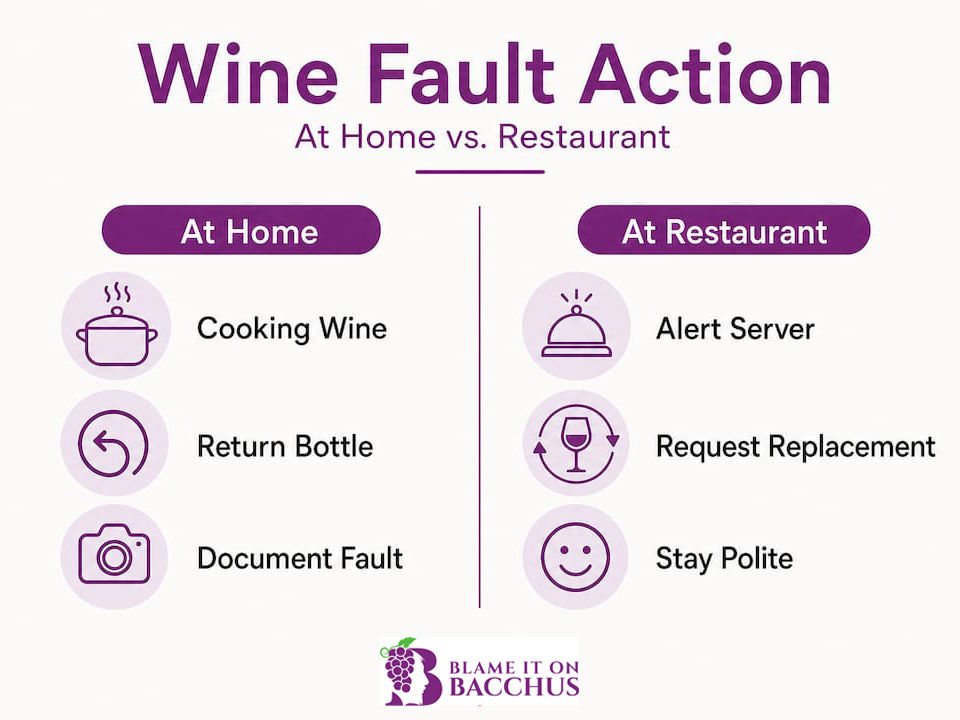
Finding a fault doesn’t have to be awkward or wasteful. Let’s break down your options based on where you are and how serious the fault is.
At a restaurant: Wine returns are completely normal and expected. Politely let your server or sommelier know that you think the wine may be corked or faulty. Use specific language: “It has a musty smell I don’t think is intentional.” Most restaurants will replace the bottle without question and are grateful you flagged it.
At a wine shop or store: Many shops will replace a faulty bottle, especially if you return it promptly with the receipt. Bring the bottle back with the cork if possible. Be specific about what you noticed.
At home with friends: This one requires a little social grace. If you suspect a fault, it’s okay to mention it casually without making it a whole event. Something like “Does this smell a bit off to you?” opens the conversation. Sometimes a second opinion helps confirm whether it’s really a fault or just an unfamiliar style.
What about wines with minor faults? Here’s where things get practical:
Slightly oxidized wine can work beautifully in a pan sauce, risotto, or braised dish. The oxidized notes actually complement savory cooking.
Mildly corked wine (where the fault is faint) can sometimes be used for cooking too, though heavily corked wine usually ruins food as well.
Volatile acidity at low levels can add brightness to marinades and dressings. Don’t toss it down the drain just yet.
As the wine terminology guide notes, some flawed wines can be used for cooking where the fault is masked by heat and other ingredients. Think of it as giving the wine a second life.
Knowing how to pair wine with food and how to handle serving wine properly also helps you make the most of whatever’s in the bottle, flawed or not.
Pro Tip: Keep a designated “cooking wine” shelf in your kitchen. Any bottle that’s slightly past its best or borderline faulty goes there. It’s practical, zero-waste, and your pasta will thank you.
A fresh perspective: Why finding wine faults makes you a better taster
Here’s something I genuinely believe, and I’ll say it plainly: learning about wine faults is one of the fastest ways to develop a seriously sharp palate. Faster than memorizing grape varieties. Faster than touring wine regions. Faster than reading every wine book on the shelf.
Why? Because faults teach you what wine shouldn’t taste like, and that makes you hyper-aware of everything it should taste like. Every time you catch a musty whiff of cork taint or notice that telltale vinegar sting, you’re training your brain to recognize contrast. And contrast is what appreciation is built on.
There’s also a confidence thing happening here. When you can walk into a restaurant, smell a glass, and calmly say “I think this might be corked,” you stop being a passive participant in your own wine experience. You become someone who knows their stuff. That shift is huge. And it’s not about being difficult or showing off. It’s about enjoying your money’s worth and honoring your own palate.
I also want to challenge the idea that a “flawed” bottle is always a ruined evening. Some of my most memorable wine conversations have started with someone saying “Wait, does this smell weird to you?” That curiosity, that shared investigation, creates connection. The odd bottle teaches you more than a hundred perfect ones ever could.
Building wine confidence is a journey, and spotting faults is one of the most underrated milestones along the way. Don’t skip it. Lean into it.
Take your wine knowledge further
Ready to keep building your expertise? Here’s where to go next.
If you’ve made it this far, you’re clearly not just a casual sipper. You’re someone who wants to actually understand what’s in the glass, and I love that energy. The next step is taking that curiosity into a more structured, guided experience where you can taste, learn, and ask questions in real time.

At Blame It On Bacchus, we offer private wine classes designed specifically for beginners who want to level up without the stuffiness of a traditional wine course. Fun, accessible, and genuinely useful. If you want to go even deeper into the foundational stuff first, the elements of wine guide is a fantastic place to explore. We’ve also got wine-themed merchandise for when you want to share the love with fellow wine fans. Come hang out. The wine is waiting.
Frequently asked questions
What is the most common wine fault?
Cork taint is the most common wine fault, recognizable by its musty, wet cardboard smell caused by a compound called TCA. It’s estimated to affect a small but significant percentage of cork-sealed bottles each year.
Can you fix a faulty wine?
Most wine faults can’t be reversed once they’re present, but minor issues like slight reduction may improve briefly with aeration. As noted in the wine terminology guide, some flawed wines can still be used for cooking where the fault becomes undetectable.
How do I know if my wine is just unusual or truly faulty?
Check for the classic fault profiles like mustiness, vinegar, or barnyard aromas. As the beginner’s guide to identifying wine aromas explains, not every odd smell signals a fault since some wines have intentionally complex or unfamiliar aromas based on their style or region.
Is faulty wine safe to drink?
Most wine faults are unpleasant but not harmful. The wine terminology explained guide covers the key terms you need to know. Always trust your senses though. If something seems seriously wrong, it’s okay to pour it out.
Should I return a wine if I suspect a fault?
Absolutely yes. Whether you’re at a restaurant or a wine shop, returning a genuinely faulty bottle is completely appropriate and expected. Be calm, be specific about what you noticed, and most places will replace it without any fuss.
Recommended
header.all-comments