How to Use a Wine Refractometer: Brix to ABV


A wine refractometer measures how much light bends through a liquid sample, converting that refractive index into %Brix, which tells you the dissolved sugar content of your grape juice or must. Here’s the fastest reliable workflow: do a daily zero-check with distilled water, place 2–3 drops on the prism, wait for the sample to reach the same temperature as the instrument before reading, then read your %Brix. Before fermentation, that number converts directly to potential alcohol. After fermentation, you’ll need either a hydrometer reading or an R‑D correction formula to get an accurate ABV estimate. That’s the whole game. Let’s walk through it step by step.
Quick workflow at a glance:
Zero your refractometer with distilled or deionized water before every session
Draw a clear, settled sample using a plastic pipette (never metal)
Place 2–3 drops on the prism, close the cover plate, and avoid air bubbles
Wait a suitable amount of time if your sample temperature differs significantly from the instrument to allow thermal equilibration
Read %Brix, then convert using a pre-fermentation formula or R‑D correction for fermented samples
Rinse the prism with distilled water and dry with a lint-free tissue after every reading
Key Takeaways
A wine refractometer gives you reliable Brix readings only when you zero it daily with distilled water, use a clear settled sample, and apply an R‑D correction or hydrometer check for any post-fermentation ABV estimate.
Point | Details |
Daily zero-check | Calibrate with distilled water every session; re-zero after battery changes or temperature shifts. |
Sample clarity matters | Let solids settle or centrifuge before applying to the prism; cloudy samples skew readings. |
Pre-fermentation conversion | Multiply Brix by 0.55 for a quick potential ABV estimate, or use the fuller formula for precision. |
Post-fermentation correction | Use original Brix (OB) plus current reading (NB) in an R‑D calculator; target accuracy is about ±0.5% ABV with hydrometer confirmation. |
Blameitonbacchus classes | The Elements of Wine class covers Brix, ABV estimation, and tasting in a beginner-friendly format with demos and Q&A. |
Table of Contents
What equipment do you need before you start?
Gather these before your first reading. Missing even one item can tank your accuracy.
Essential gear:
A temperature-compensated wine refractometer (handheld analog or digital portable)
Distilled or deionized water for calibration
Plastic disposable pipettes (one per sample to avoid cross-contamination)
Lint-free tissues or lens wipes for drying the prism
Small clean sample jars or tubes for settling juice
A calibrated thermometer to monitor sample temperature
A hydrometer and hydrometer jar for ABV verification after fermentation
Device examples worth knowing:
The Hanna HI96814 is a digital wine refractometer that converts refractive index to %Brix using the ICUMSA conversion standard. It also displays °Oechsle and °KMW, includes automatic temperature compensation (ATC), and returns results in about 1.5 seconds. The OPTi and Eclipse lines from Xylem/Zeiss are handheld analog options popular in vineyard fieldwork, offering solid optical clarity and a simple zeroing screw. Both styles work well; the choice comes down to how often you test and whether you want a digital readout or don’t mind squinting at a scale.
Consumables and safety:
Wear gloves when handling fresh must or sanitizing solutions
Use only plastic pipettes on the prism surface — metal scratches the optical glass permanently
Keep a small spray bottle of distilled water at your station for quick rinses between samples
How to use a wine refractometer step by step
This procedure works for both handheld analog and digital portable models. Follow it in order and you’ll get a reliable reading on your first try.
Zero-check the instrument. Place 2–3 drops of distilled or deionized water on the prism (or fill the sample well on digital models). Per manufacturer calibration procedures, press ZERO on digital units or turn the calibration screw on analog units until the reading shows 0.0 ±0.2 °Brix. Do this every session, not just once a week.
Prepare your sample. Crush a representative handful of grapes or draw must from your tank. If sampling a tank, agitate it first to avoid stratification. Let gross solids settle for a few minutes, or centrifuge at roughly 3,500 rpm for five minutes if you need speed. You want a clear liquid fraction — cloudy samples scatter light and skew readings. The industry-endorsed standard procedure recommends samples near 20°C (68°F) for best accuracy.
Apply the sample. Using a fresh plastic pipette, place 2–3 drops on the prism and close the cover plate. Northern Brewer’s practical guidance confirms that full prism coverage without air bubbles is the single most important application step. Tilt the instrument toward light to check for gaps or bubbles before reading.
Allow thermal equilibration. If your sample just came out of a cold tank or a warm fermentation vessel, wait about 60 seconds. ATC helps, but it works best when sample and instrument temperatures are close. Readings taken immediately on samples with temperatures far from the instrument may drift despite ATC.
Take the reading. On analog units, look through the eyepiece and note where the light/dark boundary crosses the Brix scale. On digital units like the HI96814, the display updates in approximately 1.5 seconds. Log the %Brix value and relevant sample details immediately.
Clean up. Absorb the sample with a lint-free tissue, rinse the prism with distilled water, and dry it gently. Never rub hard or use paper towels — both scratch the optical surface.
Pro Tip: Use a fresh disposable pipette for every sample. In a vineyard with multiple blocks, cross-contamination between a 22 °Brix Cabernet and a 19 °Brix Pinot Noir sample will give you a reading that belongs to neither grape.
How do you convert Brix to potential ABV?
This is where the refractometer earns its place in your toolkit. Conversion from Brix to alcohol requires different methods before and after fermentation.
Pre-fermentation conversion:
Read your %Brix from the refractometer.
Apply the common rule of thumb: potential ABV is roughly proportional to Brix. A must reading of 24 °Brix gives you roughly 13.2% potential ABV. For a slightly more precise result, use the formula ABV = (Brix × 0.59) − 0.6, which accounts for yeast efficiency and fermentation losses.
Use this estimate to inform harvest timing and adjustments.
Post-fermentation correction (the R‑D method):
Once alcohol is present, it raises the refractive index independently of sugar. A raw refractometer reading on finished wine will read higher than the actual residual sugar. You need two values: your original Brix (OB) from before fermentation and your new Brix (NB) from the current refractometer reading.
Record OB (your pre-fermentation Brix reading).
Take a current NB reading from the refractometer.
Use both values in an R-D correction method or calculator. The correction subtracts the alcohol-induced refractive index shift to give you corrected final gravity and estimated ABV.
Cross-check with a hydrometer reading for improved accuracy.
Worked example: OB = 24 °Brix, NB (post-fermentation refractometer) = 6.2 °Brix. Without the correction, you’d misread that 6.2 °Brix as meaningful residual sugar.
Accuracy note: Combining a refractometer reading with a hydrometer SG and applying careful temperature control can produce an ABV estimate accurate to about ±0.5% ABV. That’s good enough for most home and small-winery decisions.
Understanding how wine sweetness and residual sugar interact with perceived balance makes these Brix readings even more useful at harvest time.
Can you use a refractometer after fermentation?
Yes, but with a big asterisk. Raw refractometer readings after fermentation must be corrected for alcohol interference. Alcohol affects the refractive index, causing refractometers to overestimate dissolved solids after fermentation. A wine that has fermented dry might show 5–7 °Brix on a refractometer even though almost no sugar remains.
When correction works well:
You have an accurate original Brix reading from before fermentation
The wine is relatively clear (not loaded with yeast or solids)
You use a validated online calculator or spreadsheet with OB and NB inputs
Alcohol is within moderate levels where corrections remain reasonably reliable
When to skip the refractometer and grab the hydrometer:
The sample is cloudy or full of particulate matter
High phenolics (heavy red must) are present, which can further skew refractive index
You need a legally defensible or highly precise ABV figure (use distillation per AOAC/OIV methods instead)
The wine has been fortified or has alcohol above 15% ABV
Warning: Do not use single post-fermentation refractometer readings for ABV without applying proper correction formulas. That shortcut is the most common refractometer mistake in home winemaking, per homebrew community guidance.
Troubleshooting common refractometer errors
Bad readings are almost always caused by one of a handful of fixable problems. Here’s how to diagnose and correct them.
Top causes of bad readings:
Device not calibrated before use (daily zero-check skipped)
Dirty or scratched prism (residue from a previous sample, or damage from metal tools)
Air bubbles under the cover plate
Sample temperature differing significantly from the instrument
Cloudy sample with suspended solids or active yeast
Using metal pipettes or tools that scratch the optical surface
Troubleshooting checklist:
Re-zero with fresh distilled water and retake the reading
Clean the prism, dry it, and inspect for scratches under good light
Draw a fresh sample, let it settle longer, and re-apply without bubbles
Allow sufficient equilibration time if temperatures differ
Compare your refractometer reading against a hydrometer on the same sample
Accuracy benchmark: The refractometer-plus-hydrometer method, applied with matched temperatures and careful technique, achieves about ±0.5% ABV accuracy. If your two instruments disagree by more than 1% ABV, suspect a calibration or sample-prep issue before trusting either reading.
ATC functions within certain temperature limits; outside that range, temperature compensation is less effective. If your cellar drops below freezing or your must is steaming hot, wait until temperatures normalize before measuring.
Which type of refractometer should you choose?
The right tool depends on how often you test and where you test it.
Handheld analog refractometers are the low-cost workhorse for occasional field checks. They’re durable, need no batteries, and give you a quick visual Brix reading in sunlight. The trade-off is eye fatigue on a busy harvest day and the need for careful scale reading. Frequent zeroing is a must.
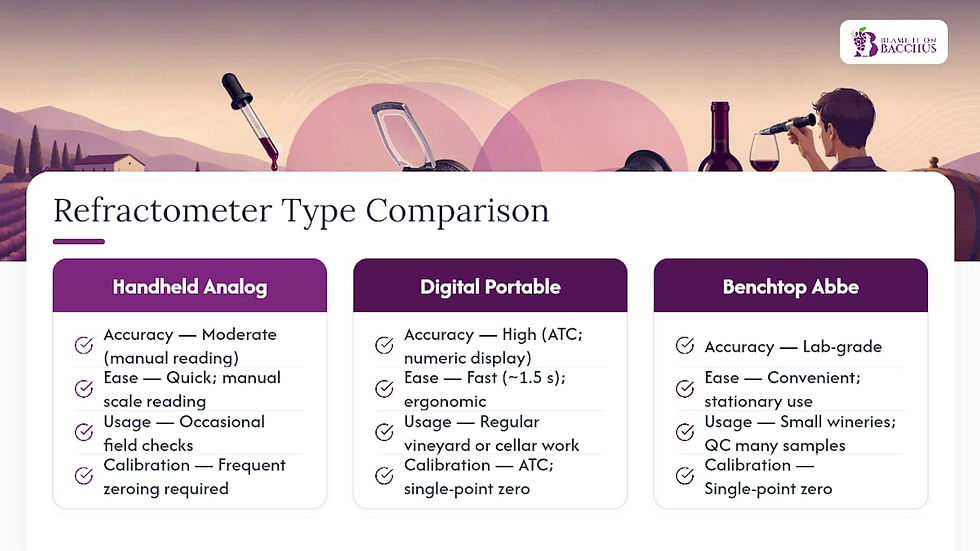
Digital portable refractometers like the Hanna HI96814 are the sweet spot for regular vineyard or cellar work. ATC, a numeric display, and multi-scale output (Brix, °Oechsle, °KMW) remove most of the human-error variables. Results in ~1.5 seconds means you can run through a lot of samples quickly. The OPTi and Eclipse lines from Xylem/Zeiss occupy a similar space, with optical precision and ergonomic designs built for field use.
Benchtop or Palm Abbe refractometers suit small wineries running quality-control checks on many samples per day. They offer lab-grade accuracy and convenience when you’re not moving around, but they’re overkill for a home vintner checking one tank.
Features to prioritize regardless of type: ATC, single-point zero calibration with distilled water, a well-designed sample well or prism cover, and an IP rating if you’re working in wet conditions.
Calibration and maintenance best practices
Calibration should be regularly performed, ideally daily, to ensure accurate readings.
Daily routine:
Zero-check with distilled or deionized water before every measurement session
Re-zero after a long series of readings, a battery change, or a significant shift in ambient temperature
Rinse and dry the prism after every single sample
Weekly upper-scale verification:
Per manufacturer and industry SOP guidance, use certified Brix standard solutions (commonly 18 °Brix and 25.2 °Brix) to verify that your instrument reads accurately across its range, not just at zero. An instrument that zeros perfectly but drifts at 22 °Brix will give you bad harvest data right when you need it most.
Maintenance do’s and don’ts:
Use only plastic pipettes on the prism
Do not immerse the refractometer in water or other liquids.
Never use metal tools, abrasive cloths, or paper towels on the optical surface
Store the instrument in its case, away from direct sunlight and temperature extremes
Refractometer check log (suggested format):
Keeping this log takes two minutes per session. It also tells you immediately when an instrument is drifting and needs service, before it costs you a harvest decision.

A wine educator’s take on field vs. cellar routines
Here’s what I’ve seen separate confident home vintners from frustrated ones: it’s not the equipment. It’s the habit.

A one-minute daily check before you touch any sample is non-negotiable. Zero the device, confirm it reads 0.0, and you’re done. For harvest sampling, build a five-minute routine: agitate the tank or collect grapes from multiple vine positions (not just the end of the row, where ripeness is often unrepresentative), settle the juice, and take three readings from different subsamples. Average them. Pair that number with a quick taste and a pH strip, because Brix alone doesn’t tell you about acidity or phenolic ripeness; tools like the Vinoperte wine selection app can help you explore these aspects alongside your measures. The refractometer is your speedometer, not your GPS.
The non-obvious tip most guides skip: in bright sunlight, the light/dark boundary on an analog refractometer can wash out. Cup your hand over the eyepiece or step into shade before reading. It sounds trivial until you’re squinting at 24 °Brix and misreading it as 22 °Brix on a critical harvest morning.
Pro Tip: Build a simple spreadsheet with columns for date, sample source, OB, NB, and a formula cell that auto-calculates corrected ABV using the R‑D method. After a few harvests, you’ll have a personal dataset that shows ripening curves by block, which is genuinely useful for timing future harvests.
For deeper sensory context alongside your numbers, pairing refractometer data with tasting notes gives you a much richer picture of where your grapes actually are.
Ready to go deeper on wine basics?
If this guide got your winemaking brain buzzing, Blameitonbacchus has a class built exactly for where you are right now. The Elements of Wine covers Brix, ABV estimation, and sensory tasting in a beginner-friendly format with live demos and Q&A. No lab coat required. It’s the structured foundation that makes all these measurement steps click into place, because knowing how to read a refractometer is one thing, and knowing what to do with that number is where the real fun starts.

Whether you’re making your first five-gallon batch or managing a small cellar, the class gives you the vocabulary, the context, and the confidence to trust your readings. Head over to Blameitonbacchus to see what’s available and grab your spot.
Sources
These are the primary references behind the calibration steps, sample prep standards, and conversion guidance in this guide.
FAQ
What is a good Brix level for wine grapes at harvest?
The ideal target depends on the grape variety, style of wine, and regional climate.
Can you use a refractometer after fermentation?
Yes, but the raw reading is not accurate on its own. Alcohol raises the refractive index, so you must apply an R‑D correction using your original Brix and current reading, or cross-check with a hydrometer, to get a reliable final gravity or ABV estimate.
How do you read a refractometer for alcohol content?
For pre-fermentation samples, read %Brix and multiply by approximately 0.55 for a quick potential ABV estimate. For post-fermentation samples, use both the original Brix (OB) and the current refractometer reading (NB) in a correction calculator to account for alcohol’s effect on refractive index.
Are alcohol refractometers accurate?
Without correction for alcohol, post-fermentation readings alone can be off by several percentage points.
Recommended
Comments