Why blind wine tasting builds real confidence fast

Updated: May 25

TL;DR:
Blind wine tasting reveals true preferences by eliminating label and price biases.
Experts and beginners alike often can’t distinguish expensive wine from cheaper options in blind tests.
Practicing blind tasting builds confidence, enhances palate awareness, and celebrates personal taste.
Here’s a little truth bomb: even seasoned wine experts often can’t tell a $10 bottle from a $100 one when the label is hidden. Wild, right? A famous fMRI study found that our brains literally experience more pleasure when we believe a wine is expensive, even if it’s the exact same pour. That means a lot of what we “taste” is actually in our heads. Blind wine tasting strips all of that away. It forces you to focus on what’s actually in the glass, not what the label tells you to think. And I promise, the results are eye-opening, in the best possible way.
Table of Contents
Key Takeaways
Point | Details |
Bias-free tasting | Blind tasting removes price and label bias so you discover true wine preferences. |
Anyone can blind taste | Blind wine tasting is accessible for all levels and can be done easily at home. |
Proven by history | Blind tastings have repeatedly revealed surprising wine winners and reshaped expectations. |
Builds confidence | Practicing blind tasting helps you trust your palate over reputation or marketing. |
What is blind wine tasting and why does it matter?
Let’s start at the beginning. Blind wine tasting sounds fancy, but it really isn’t. At its core, it just means you taste a wine without knowing anything about it beforehand. No brand name. No grape variety. No price tag. No vintage year on display. Just wine in a glass, your nose, and your taste buds.
That’s it. No secret handshake required.
The whole point is to remove outside noise. When you don’t know what you’re drinking, you stop second-guessing yourself. You stop thinking, “Well, this is a Bordeaux, so it’s supposed to taste like…” and you just… taste. It’s honestly one of the most freeing experiences in wine drinking. I know that sounds dramatic, but stay with me.
Here’s what blind tasting helps you discover:
What you actually like, not what wine critics say you should like
Hidden value, because budget bottles often perform surprisingly well
Your personal palate, which is unique to you and worth understanding
Real differences between wines, without the distraction of branding or prestige
Confidence in your own senses, which is everything when you’re shopping for wine
The science backing this up is genuinely fascinating. Research on blind wine tasting involving 500 or more participants showed that people could not reliably tell cheap wine from expensive wine any better than random chance. That’s not a fluke. That’s a pattern repeated across multiple large studies.
“The wine we think we’re drinking is often not the wine we’re actually tasting. Our expectations do the heavy lifting.” This idea is at the heart of why blind tasting matters so much.
Building wine basics for confidence starts with understanding your own preferences, and blind tasting is one of the fastest ways to get there. Once you know what your palate actually gravitates toward, choosing wines gets so much easier and more fun.
Pro Tip: Before your first blind tasting, spend 10 minutes brushing up on essential wine terms like “tannins,” “acidity,” and “body.” You don’t need a PhD in wine. Just a few key words will help you describe what you’re experiencing, which makes the whole thing even more rewarding.
And here’s the kicker: you can do this at home, tonight, for the price of two bottles of wine. No fancy tasting room needed. No sommelier on standby. Just you, a friend, some paper bags or foil, and a genuine curiosity about what’s actually in your glass.
How bias shapes our wine experiences
With a clear idea of what blind tasting is, let’s look at why it’s necessary: our own biases can dramatically shape what we think we taste.
This is where things get really interesting and a little humbling.
Our brains are incredible storytelling machines. When we see a gorgeous wine label with an elegant château on it, our brain starts writing a story before we even take a sip. “This is probably rich, complex, worth the money.” And then, almost magically, that’s what we taste. The brain fills in the gaps, bends the experience to match the expectation. It’s not lying to you. It genuinely believes the story it’s telling.

Here’s a jaw-dropping example. The same wine labeled as expensive triggered measurably more pleasure in brain scans than the exact same wine labeled as cheap, according to fMRI research on price bias. The wine didn’t change. The perception did.
Now check out this comparison between how we perceive wine with vs. without the label:
Factor | With label visible | In blind tasting |
Price influence | High, often inflates perceived quality | Removed completely |
Brand reputation | Shapes expectations strongly | Irrelevant |
Personal confidence | Often lower for beginners | Often higher |
Honest preference | Harder to access | Much easier to identify |
Surprise factor | Low | Very high |
The table tells a real story. When the label is gone, everything shifts.
And it’s not just everyday drinkers who fall for this. Experts do too. A landmark study by researcher Robert Hodgson at the California State Fair found that judges awarded medals randomly, with the same wines receiving wildly different scores when tasted multiple times. Even more jaw-dropping: trained professionals mistakenly identified a dyed white wine as red. Yes, you read that correctly.
Statistic to chew on: In Hodgson’s research, fewer than 10% of wine judges showed consistent results across repeated evaluations of the same wine.
Pro Tip: Next time you open a bottle, cover the label with foil before your first sip. Form your opinion first, then reveal the wine. You might surprise yourself at how different your reaction is when your brain isn’t running its usual bias program.
Exploring the elements of tasting without the influence of labels is a game-changing experience. And understanding wine balance and bias can help you start separating what you genuinely enjoy from what marketing has convinced you to enjoy.
The takeaway here isn’t that wine experts are bad at their jobs. It’s that human perception is wildly susceptible to context. Which means blind tasting isn’t just a fun party trick. It’s a genuine tool for self-discovery.
Famous moments: How blind tasting changed wine history
Now let’s see how blind wine tasting hasn’t just helped individuals. It’s changed the course of wine history.
The most legendary example? The Judgment of Paris. In 1976, a British wine merchant named Steven Spurrier organized a blind tasting in France. The judges were top French wine critics, the kinds of people whose opinions could make or break a winery. The lineup included both French wines and California wines, which at the time were considered a charming novelty at best.
The result? California wines beat French in both the red and white categories. The French judges were stunned. Some even tried to take back their scorecards. The wine world was never the same.
“The Judgment of Paris proved that wine quality transcends geography, tradition, and reputation. The glass doesn’t lie.”
Here’s a quick look at what made that moment so historic:
Detail | Information |
Event | Judgment of Paris |
Year | 1976 |
Location | Paris, France |
Judges | Top French wine critics |
Winner (reds) | Stag’s Leap Wine Cellars, California |
Winner (whites) | Chateau Montelena, California |
Impact | Launched California wine onto the world stage |
What does this have to do with you as a beginner? Everything.
It proves that prestige and tradition don’t guarantee quality. A wine from a lesser-known region, a lesser-known grape, or a lower price point can absolutely hold its own or even win outright when judged purely on taste. That’s empowering.
Here are a few other powerful facts about blind tasting in the professional world:
Most major international wine competitions use blind tasting to ensure fairness
The Decanter World Wine Awards, one of the biggest competitions globally, uses fully blind judging panels
Many wine schools teach blind tasting as the foundation of a real wine education
Sommeliers who pass top certifications must demonstrate blind tasting skills
This isn’t just gatekeeping for wine professionals. It’s an acknowledgment that blind tasting is the most honest and fair way to evaluate wine. And that’s a skill worth having, no matter your experience level.
Knowing how to use a wine scoring guide can help you make sense of your blind tasting notes. And if you want to understand how age affects what’s in your glass, brushing up on wine vintage basics will give your palate even more context when you’re tasting blind.
How to start blind tasting: Simple steps for beginners
Inspired to try for yourself? Blind tasting at home isn’t complicated. Here’s how to get started. No special equipment or training required.
Let’s set the scene. You and a couple of friends, a few bottles of wine in various price ranges, and zero idea which is which. That’s the dream setup. Here’s how to make it happen:
Gather your wines. Pick three to five bottles across different price ranges. You don’t need to spend a fortune. A $12 bottle, a $20 bottle, and a $35 bottle is a perfect starting lineup. Try to keep the grape variety the same (all Chardonnays or all Cabernets) so you’re comparing apples to apples.
Wrap the bottles. Use foil, paper bags, or a clean cloth to cover each bottle completely. Number them with a marker so you can track which is which at the reveal, but no one except the organizer knows the order.
Set up scorecards. Give everyone a simple scoring sheet. Ask them to rate each wine on a scale of 1 to 10 for color, aroma, taste, and overall enjoyment. Keep it simple and fun.
Pour and taste. Pour small amounts, about an ounce or two per person per wine. Encourage everyone to smell first, then sip slowly. No peeking, no sharing opinions out loud until everyone has scored all the wines.
Reveal and compare. This is the magic moment. Uncover the bottles and reveal which wine corresponds to which number. Compare scores. Celebrate surprises. Laugh at the results.
Talk about it. Discuss what flavors you picked up, what you liked, what surprised you. This is where the real learning happens.
A few common beginner mistakes to watch out for:
Pouring too much. Small pours keep palates fresh and prevent bias from “committing” to a glass.
Sharing opinions mid-tasting. One person’s enthusiasm can easily sway others. Keep it quiet until scores are in.
Only tasting one wine style. Mix it up over time. Try reds one night, whites another. Explore regions and grapes.
Skipping the sniff. Aroma gives you enormous information. Take your time with your nose before your first sip.
This kind of hands-on practice is exactly what helps you taste wine like a pro, and understanding how wine aging and tasting interact will add even more depth to your tasting notes as you grow.
Pro Tip: Because even professional judges have been shown to award medals inconsistently in blind settings, don’t stress if your scores feel “wrong.” There’s no wrong answer. Your palate is valid.
The bottom line is that your first blind tasting doesn’t need to be perfect. It just needs to happen. The more you practice, the more your palate sharpens, and the more fun the whole thing becomes.
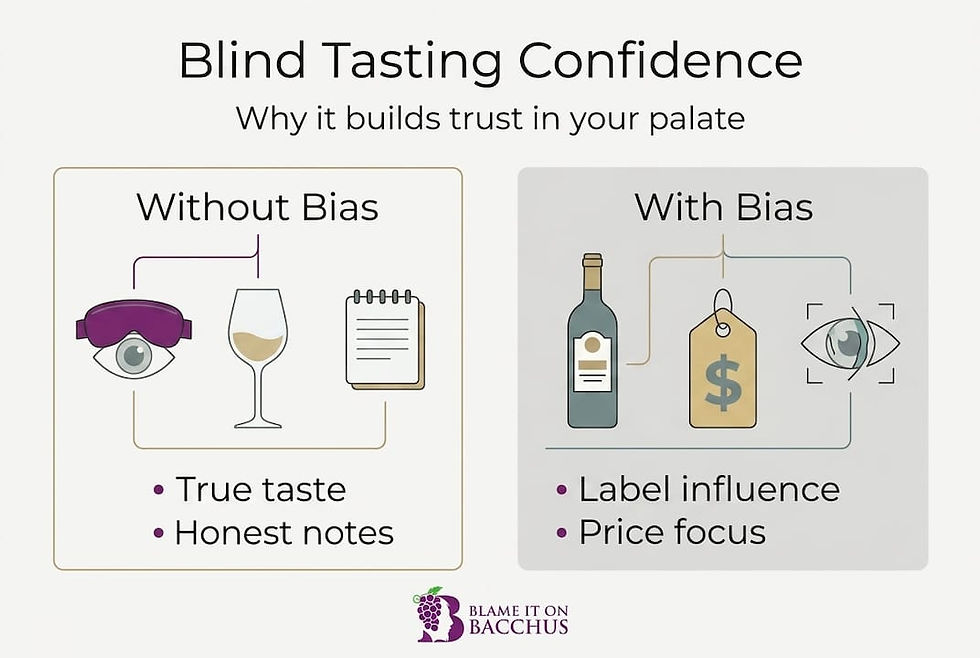
Our take: Why blind tasting builds real wine confidence
Here’s my honest take, built from years of watching beginners transform into genuinely confident wine drinkers: blind tasting is the single best thing you can do for your wine journey early on.
Here’s the thing most wine guides won’t tell you. The biggest barrier for new wine drinkers isn’t lack of knowledge. It’s self-doubt. People are afraid to trust their own palate because they assume experts and expensive labels know better. Blind tasting blows that assumption apart immediately.
When you discover your $15 pick outscored the $50 bottle in your own blind test, something shifts. You stop outsourcing your opinions to critics and start owning them. That’s powerful. And it makes every future wine experience richer because you’re actually present in it.
Getting familiar with wine terms for beginners gives you the vocabulary to describe what your senses are already picking up. Pair that vocabulary with regular blind tasting practice, and you’ve got a genuine skill set. Not a borrowed one from a review app. Your own.
Wine is for everyone. Not just collectors. Not just sommeliers. You deserve to enjoy it on your own terms.
Ready to deepen your wine skills? Explore more with us
Blind tasting has a sneaky way of lighting a fire. Once you discover just how much your own palate can tell you, you’ll want to keep going, keep exploring, and keep surprising yourself.
That’s exactly where we come in. At Blame It On Bacchus, we offer private wine classes designed specifically for curious beginners who want real skills without the stuffiness. Our classes are fun, interactive, and built around your enjoyment, not intimidating rules. If you want to take your tasting further with hands-on practice, our interactive wine challenge is a fantastic next step. And if you’re shopping for a fellow wine lover, browse our wine-themed merchandise for the perfect gift. Let’s make your next pour the most exciting one yet.
Frequently asked questions
Why do people do blind wine tastings?
Blind tastings remove bias from price and label, helping tasters discover which wines they honestly prefer. Research consistently shows that perceived price heavily distorts our enjoyment, so tasting blind gives you a truer read on what your palate actually loves.
Can beginners really benefit from blind tasting?
Absolutely. Blind tasting allows beginners to focus on personal taste and develop confidence without being swayed by brand or cost. As the Judgment of Paris showed, even seasoned experts can be surprised by what their honest palates prefer.
How do you organize a blind wine tasting at home?
Cover bottles with foil or paper bags, number them, and hand out simple scorecards so tasters can judge purely by taste and aroma. Since even professional judges show inconsistency in blind settings, don’t overthink it. Just make it fun.
Does the price of wine really matter in blind tastings?
Most research finds that even experienced tasters can’t reliably distinguish expensive wine from inexpensive in blind tests. Studies involving 500 or more participants showed results no better than random chance, which means price is much less predictive of enjoyment than we think.
Recommended
Comments