What is a wine appellation? How regions define your wine


TL;DR:
Appellations identify the geographic origin and regulate production rules of wines.
They protect authenticity but do not guarantee wine quality or personal enjoyment.
Understanding appellations helps consumers choose regional styles and explore new wines confidently.
You’ve probably stood in a wine aisle, stared at a bottle labeled “Burgundy” or “Napa Valley,” and thought, “Cool, but what does that actually mean?” Here’s the thing: those region names aren’t just pretty marketing. A wine appellation is a legally protected geographical indication that tells you where the grapes came from and, often, exactly how the wine was made. It’s the difference between a name that means something and a name that means nothing. This guide is here to break it all down so you can read a wine label like a pro and actually enjoy the hunt for your next favorite bottle.
Table of Contents
Key Takeaways
Point | Details |
Appellation defines origin | A wine appellation gives legal protection to where a wine is made and under what rules. |
Rules vary by region | European appellations are stricter, while American ones focus mostly on grape origin. |
Quality is not guaranteed | Appellation signals standards, but producer skill and choices matter most for quality. |
Use labels smartly | Reading appellation info can help you explore new regions and find wines that match your taste. |
Understanding wine appellations: The basics
Let’s start simple. An appellation is basically a wine’s official address. It tells you where the grapes were grown, and in many cases, it also sets the rules for what grapes can be used and how the wine has to be made. Think of it like a recipe with legal teeth.
Why does this exist? Two big reasons: authenticity and trust. Without these protections, anyone could slap “Champagne” on a bottle of fizzy grape juice from, well, anywhere. Appellations protect the real deal and help fight wine fraud, which is a much bigger problem in the wine world than most people realize.
Here’s a quick snapshot of what appellations typically cover:
Geographic origin: Where exactly the grapes were grown
Permitted grape varieties: Which wine grape varieties are allowed in the blend
Production methods: How the wine is fermented, aged, or blended
Labeling rules: What the producer can and cannot say on the bottle
Now, here’s something important to keep in mind. As a basic wine guide principle, appellation doesn’t guarantee quality. It guarantees compliance with regional standards. A wine can follow every rule and still taste mediocre. More on that in a minute.
The history here is actually pretty fascinating. The Chianti region in Italy was declared a protected zone all the way back in 1716, making it one of the earliest official appellations in the world. France followed with its AOC (Appellation d’Origine Contrôlée) system in 1935, largely to combat rampant wine fraud. So yes, this stuff has been serious business for a very long time.
“A wine appellation is a legally protected geographical indication identifying the origin of wine grapes, often with additional restrictions on production to ensure quality and typicity tied to the region.”
Now that you see why this matters, let’s break down what “appellation” actually means for your next bottle.
How wine appellation systems work
Every official appellation system rests on three big pillars. Once you understand these, the whole thing clicks into place.
Appellation systems operate on three core principles: geographic delimitation, specification, and enforcement. Here’s what each one means in plain English:
Geographic delimitation: This is the map part. Officials draw boundaries around a specific region, like Bordeaux in France or Willamette Valley in Oregon. Only grapes grown inside those lines can carry the appellation name. Sounds simple, but those boundary decisions can be wildly political and contested.
Specification: This covers the rulebook. What grapes can you grow? How high can yields be? Do you have to age in oak? These specs vary enormously between regions. Burgundy, for example, has incredibly strict rules. A California AVA (American Viticultural Area)? Much more relaxed.
Enforcement: Rules mean nothing without someone checking. Appellation bodies conduct inspections, taste wines, and can take legal action against producers who cheat. This is what gives the system its actual power.
Knowing how wine rules affect your glass helps you appreciate why two bottles from the same region can taste completely different. The rules set a floor, not a ceiling.
Pro Tip: Even within the same appellation, not all producers are equal. The name on the region is just the starting point. Dig into the producer’s reputation for a much better guide to what’s in the glass.
Old World vs. New World: What’s the difference?
We’ve seen the principles. Now let’s compare how these play out depending on where your wine comes from.
Old World wines (think France, Italy, Spain) tend to operate under strict systems that emphasize terroir, which is the French idea that the land itself shapes the wine’s flavor. These systems are tightly regulated.

New World wines (think California, Australia, Argentina) take a more flexible approach. The focus is often on the grape variety and the winemaker’s style rather than centuries of tradition.
Here’s a side-by-side look:
Feature | PDO (Old World) | PGI (Old World) | AVA (US) |
Origin requirement | 100% from region | 85% from region | 85% from region |
Grape variety rules | Strict | Moderate | None |
Production method rules | Strict | Some | None |
Examples | AOC, DOCG | IGT, Vin de Pays | Napa Valley, Willamette Valley |
Flexibility | Low | Medium | High |
The EU framework divides designations into PDO (Protected Designation of Origin) and PGI (Protected Geographical Indication). PDO is the strictest tier, requiring 100% regional origin and tight production rules. PGI is looser, allowing more flexibility in grape sourcing and methods.
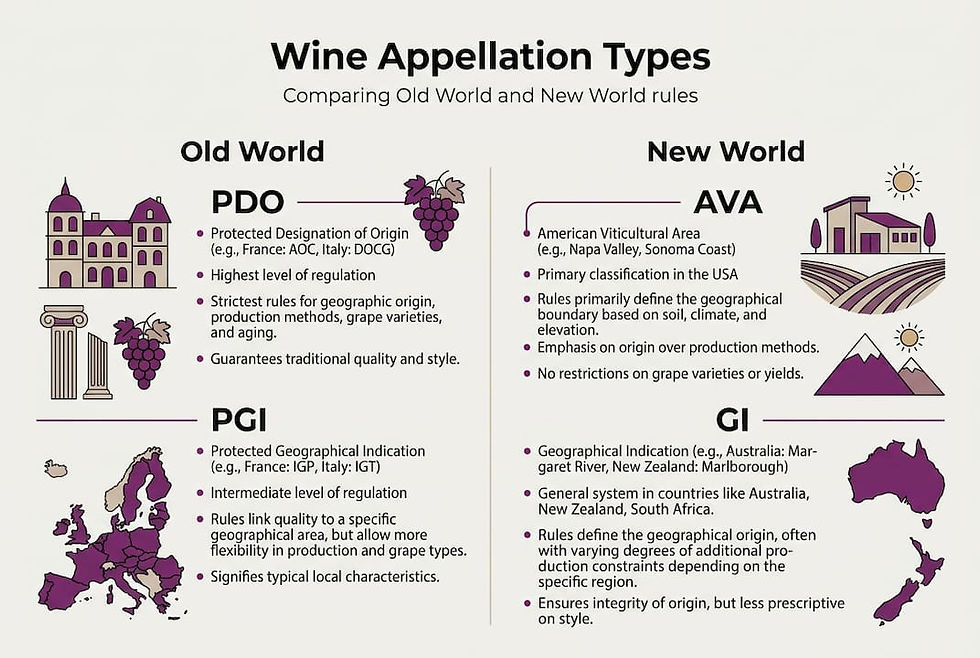
US AVAs require that 85% of the grapes come from the named area, but there are zero rules about which grape varieties to use or how to make the wine. That’s why California winemakers can get creative with blends featuring red wine varieties that would never be allowed in, say, Burgundy.
More experimentation in Napa. More tradition in Bordeaux. Both approaches have their charms.
What appellation does (and doesn’t) tell you about your wine
Understanding regional rules is crucial, but what does this mean for what you taste and pay when you pour?
Here’s the honest truth: appellation tells you where and how, not how good. The same designation can vary wildly by producer. Two bottles both labeled “Chianti Classico” can taste worlds apart depending on who made them.
Let’s talk about Super Tuscans, because this is one of the juiciest stories in wine. Back in the 1970s and 80s, some bold Italian winemakers got frustrated with the strict DOC (Denominazione di Origine Controllata) rules in Tuscany. The rules required specific grape blends that the winemakers felt limited quality. So they used the IGT designation (Indicazione Geografica Tipica), a looser category, to bypass the strict DOC rules and create blends using Cabernet Sauvignon and Merlot alongside Sangiovese. The result? Some of the most celebrated and expensive wines in Italy. The rules were meant to protect quality, but in this case, breaking free from them created something extraordinary.
Here’s what appellation can tell you:
Style clues: Knowing the region gives you a flavor profile to expect
Grape hints: Especially in Old World wines where variety isn’t always listed
Price context: Famous appellations often command higher prices, sometimes for good reason
Here’s what it can’t tell you:
Whether a specific bottle is delicious
Whether the producer is skilled or lazy
Whether you personally will love it
Pro Tip: Use appellation as your starting point for confident wine choices, then layer in producer research. The combination of region plus reputation is your real cheat code. You can also explore wine basics to build a stronger foundation for reading labels.
How to use appellations when choosing wine
Armed with the realities behind appellations, it’s time to put this knowledge to use for your next purchase or tasting.
Here’s a simple process I love for using appellation info like a seasoned shopper:
Read the label carefully. Identify the appellation name. Is it a country, a region, or a specific sub-zone? The more specific, the more rules are likely in play.
Match the region to a grape or style. Old World labels often skip the grape variety entirely. Knowing that Chablis means Chardonnay, or that Rioja means Tempranillo, is a superpower at the wine shop.
Cross-reference with the producer. A great appellation plus a trusted producer is a winning combo. A fancy appellation with an unknown producer is a gamble. Check reviews or ask your local wine shop.
Explore lesser-known appellations for value. Famous regions like Napa and Bordeaux carry a price premium. Neighboring or emerging regions often offer similar styles at friendlier prices. Think Languedoc instead of Burgundy, or Paso Robles instead of Napa.
Keep tasting notes. Write down what you liked and which appellation it came from. Over time, you’ll spot patterns in your preferences.
As origin standards remind us, the designation is about compliance, not a quality guarantee. So your own notes are honestly more reliable than any label alone. Pair your appellation knowledge with a solid quick wine basics foundation and you’ll be unstoppable at the wine shop.
Why understanding appellations matters more than ever
Here’s my honest take: most people think appellations are for collectors and sommeliers. I’d argue the opposite. They’re actually most useful for beginners.
When you’re just starting out, the wine world feels overwhelming. There are thousands of bottles, dozens of countries, and no obvious roadmap. Appellations give you a framework. They’re like zip codes for flavor. Once you know that a certain region tends to produce bold, earthy reds or crisp, mineral whites, you have a shortcut to finding what you love.
Globalization has also made this more exciting. You now have access to wines from Georgia (the country), Slovenia, and Uruguay sitting right next to your familiar Cabernet. Understanding appellation helps you make sense of these new arrivals rather than feeling intimidated by them.
And here’s the contrarian bit: the best bottle you’ll ever find might come from a region you’ve never heard of with a designation that means nothing to most people. Confident wine knowledge gives you the courage to take that leap. The fanciest label in the shop is not always the most rewarding pour. Adventure wins.
Ready to explore wine regions yourself?
If this guide got your wine curiosity buzzing, you’re in exactly the right place. At Blame It On Bacchus, we make wine education genuinely fun, no stuffy lectures or intimidating jargon.
Our wine education classes are designed for beginners and casual enthusiasts who want to actually understand what’s in their glass. Whether you want to geek out on appellations or just find wines you love, we’ve got you covered. And if you want to wear your wine passion proudly, check out our wine region apparel for a fun way to celebrate your favorite regions. Learning wine should feel like a party, and we’re here to make sure it does.
Frequently asked questions
Does a wine appellation mean the wine is high quality?
Not necessarily. Appellation means compliance with origin rules, not a guarantee of great taste. Quality still depends heavily on the individual producer.
What’s the main difference between European and American wine appellations?
European systems like PDO and AOC enforce strict rules on grape varieties and production methods, while US AVAs mainly require 85% of grapes from the named area with no restrictions on grape type or winemaking style.
How do I use appellation to pick a better wine?
Use the appellation to understand the regional style and likely grape variety, then research producers within that region. The best results come from pairing regional knowledge with producer reputation.
Why do some famous wines ignore traditional appellation rules?
Super Tuscans bypassed strict DOC rules by using the looser IGT designation, allowing winemakers to blend international grape varieties and produce some of Italy’s most celebrated and award-winning wines.
What was the first official wine appellation?
The Chianti region in Italy was declared a protected zone in 1716, earning its place as one of the earliest official wine appellations in recorded history.
Recommended
Comments